
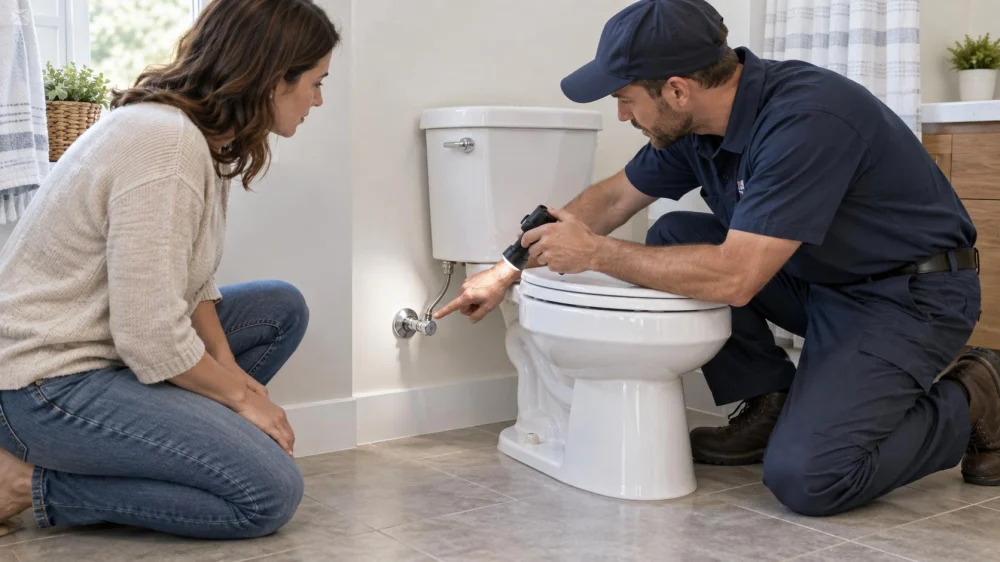
Toilet Shutoff Valve: Locate, Test Gently, and Label
On this page
Quick answer
Find the toilet’s fixture shutoff before a leak happens, usually on the wall or floor behind or beside the bowl. Inspect it for corrosion, moisture, damaged tubing, and poor access. With a plumber’s guidance and a dry floor, turn it gently without forcing a stuck valve, confirm water stops, reopen it slowly, and watch for leaks. Label the route to the main shutoff too.

Stashluk Mechanical Contractors Inc. / stashluk
Franklin TownshipHunterdon CountyNew Jersey
998 Croton Rd, Pittstown, NJ 08867, USA
Locate the valve
Follow the water-supply tube from the toilet tank toward the wall or floor. The small valve at the other end is commonly the fixture shutoff. Some concealed, wall-hung, older, or commercial toilets use a different arrangement; find the building or fixture manual or ask a plumber.
Also locate the home's main water shutoff and learn whether a utility or building manager controls it. Do not operate a street-side meter valve without authorization.
Bill Trombly Plumbing - Heating - Cooling - Electric / jim trombly heating
ManchesterHillsborough CountyNew Hampshire
76 Maple St, Manchester, NH 03103, USA
Inspect before touching
- Clear cleaners, paper, and storage from the area.
- Use a flashlight to look for droplets, stains, corrosion, cracks, or mineral buildup.
- Check whether the supply tube is kinked, rubbing, bulging, or expired under its instructions.
- Place a dry paper towel beneath connections to reveal slow moisture.
- Photograph the original position and valve type.
If the valve or pipe is heavily corroded, already leaking, loose in the wall, or difficult to reach, stop and call a plumber before testing.
Test gently
Choose a time when a plumber or main shutoff is accessible if something fails. Follow the valve manufacturer's direction. Many multi-turn valves close clockwise; quarter-turn valves usually move a short arc, but do not guess or use pliers for extra leverage.
After closing gently, flush once and confirm the tank does not refill. Reopen slowly to its normal position, let the tank fill, flush, and inspect every connection. Persistent seepage, a handle that spins, or incomplete shutoff needs repair.
During a leak
If clean water is escaping and the valve operates freely, close it and contain water without touching electrical equipment. If it does not stop the flow, use the known main shutoff if safe and authorised, then call a plumber. For sewage, contaminated water, ceiling damage, electrical contact, or structural concerns, keep people away and use appropriate emergency help.
When replacement is needed
A plumber can select a compatible valve and supply connector, assess pipe condition, and confirm code and access requirements. Replacing a valve may require shutting off and draining the home system, cutting or joining pipe, and testing under pressure. Avoid improvised caps, tape-only repairs, or tightening that twists hidden pipe.
Label and record
Use a moisture-resistant tag with a simple fixture identifier and direction arrow, without blocking operation. Record the valve location, test date, main-shutoff route, plumber, replacement part, and photographs. Make sure household members know whom to call and can reach the area without moving heavy storage.
Frequently asked questions
Should I turn the valve regularly?
Ask the plumber or manufacturer; exercising suitable valves may reveal problems, but forcing an old valve can cause a leak.
Why does the tank still fill after closing?
The valve may not be fully closed or may have failed internally; arrange repair rather than applying force.
Can I use pliers on a stuck handle?
No. Extra leverage can break the valve or hidden pipe.
Does the valve fix a running toilet?
It only controls supply. Running commonly involves tank components that require separate diagnosis.
Sources and notes
The U.S. Environmental Protection Agency's WaterSense home-maintenance guidance recommends regular leak checks and prompt attention to toilet problems. WaterSense also notes that worn toilet flappers commonly cause leaks, which is different from a failed fixture shutoff.
Next steps
Locate the toilet and main shutoffs, clear access, inspect without forcing anything, and schedule a controlled test when help is available. Label the route and call a plumber for corrosion, leakage, stiffness, incomplete shutoff, or uncertain valve type.
 Jerry's Plumbing0.0 (0 reviews)
 Eagle Plumbing & Repairs4.0 (23 reviews)
 Cain's Able Plumbing4.0 (619 reviews)
 CAC Plumbing, LLC4.0 (29 reviews)
 Pinkerton Plumbing5.0 (19 reviews)
 Jeff Underwood Plumbing5.0 (2 reviews)
 Toilet Shutoff Valve: Locate, Test Gently, and Label
 Sump Pump Test: Power, Float, Discharge, and Backup
 Water Meter Leak Check: Confirm Flow Before You Call
 Washing Machine Hoses: Inspect, Replace, and Prevent Leaks
 Slow Bathroom Sink Drain: Safe Checks Before Chemicals
 Running Toilet Diagnosis: Safe Checks Before Repair