
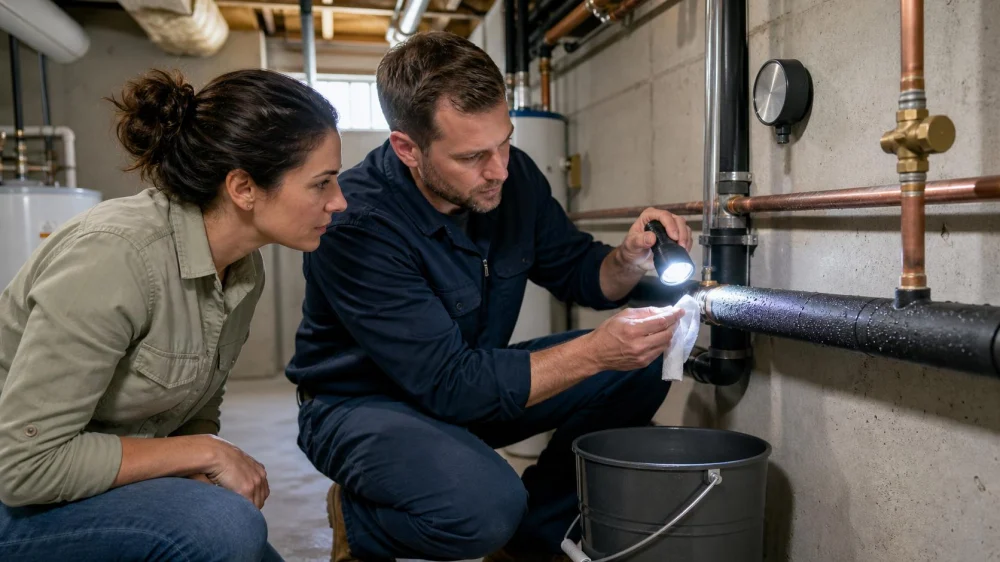
Sweating Pipes or a Leak? Dry, Observe, and Check
Table of contents
Quick answer
A cold pipe can “sweat” when humid air condenses across its surface, while a plumbing leak often begins at a joint, valve, crack, or fitting. Protect the area, dry the pipe completely, then observe where moisture returns and whether it relates to water use or room humidity. Do not open walls or tighten fittings blindly. Shut off water and call a plumber for active leakage, damage, or uncertainty.
Landry Mechanical Inc Plumbing HVAC & Electric / landry mechanical
FraminghamMiddlesex CountyMassachusetts
763 Waverly St unit 32, Framingham, MA 01702, USA
Condensation versus a leak
Condensation can form over a long section of a cold-water pipe, much like droplets on a cold glass. It is more likely in warm, humid spaces such as basements, crawl spaces, laundry rooms, and bathrooms. Droplets may be evenly distributed and increase when the pipe carries cold water.
A leak more often creates a defined wet point, drip track, spray, or stain near a connection or damaged area. Water can also travel along the outside of a pipe, so the lowest drip is not always the source. Both problems can wet insulation, framing, ceilings, and stored items, so neither should be ignored.
O'Neill Bros. Plumbing / oneill plumbing
RockvilleMontgomery CountyMaryland
12348 Wilkins Ave, Rockville, MD 20852, USA
Start with safety
- Keep people away from a sagging ceiling or damaged floor.
- Do not touch water near electrical panels, outlets, wiring, or appliances.
- Move belongings only when the area is structurally and electrically safe.
- Know the main water shutoff and fixture isolation valves.
- Use a stable work light and view from the floor; do not balance on pipes or unsafe ladders.
- Wear gloves and avoid contact with sewage or unknown contaminated water.
If water is near electricity, leave the area and contact emergency or utility professionals as appropriate. Do not enter a flooded space to reach a breaker.
Step-by-step check
- Protect below. Place a bucket or waterproof tray under the drip without blocking access.
- Photograph the starting condition. Include the full pipe run and nearby surfaces.
- Dry the pipe. Use a clean towel so new moisture is easier to locate.
- Mark observation points. Place dry paper towel strips loosely under suspect joints, without wrapping valves or hot components.
- Observe without disturbing. Note whether moisture returns across the pipe or at one location.
- Compare conditions. Record indoor humidity, appliance cycles, showers, toilet use, and fixture operation.
- Check the meter if appropriate. With all known water uses off, an unexplained movement can support a leak concern, but meter design varies.
- Document the result. Record time, moisture location, and changes for the plumber.
Read the moisture pattern
More consistent with condensation: small droplets over a broad cold surface, no single wet joint, worse during humid weather, and less moisture when humidity falls or cold-water use stops.
More consistent with leakage: a bead reforms at one joint, water appears when a fixture or appliance runs, pressure causes a fine spray, staining grows, or the meter suggests unexplained flow. A hidden leak can remain intermittent, so a dry check is not proof that the system is sound.
Also look above the pipe. Roof, foundation, HVAC drain, or appliance water may land on plumbing and create a false source.
Reduce condensation
Control indoor moisture with safe ventilation, a properly sized dehumidifier, and repairs to outside water entry. Keep condensate drains clear according to equipment instructions. Pipe insulation can reduce surface condensation, but it must be suitable for the pipe, temperature, location, and local code, with seams properly sealed.
Do not cover a suspected leak with insulation. Trapped water can hide damage and support mould growth. First confirm the pipe is sound and dry, and ask a plumber about valves, fittings, and inaccessible sections.
If a leak is likely
For an active supply leak, close the nearest safe isolation valve or main shutoff if you know how and doing so will not create another hazard. Open a lower fixture only if a plumber or your system instructions recommend relieving pressure. Call a licensed plumber and describe the pipe material, location, rate, valve status, and affected surfaces.
For drainage or sewage leakage, stop using connected fixtures and isolate the area. Avoid DIY cleanup of contaminated porous materials; use qualified restoration help when appropriate.
What to avoid
- Do not overtighten a fitting; it may crack or distort.
- Do not apply tape, putty, or clamp as a permanent unknown repair.
- Do not puncture a ceiling to release water while standing underneath.
- Do not paint over damp stains before the source and drying are resolved.
- Do not mix bleach with other cleaners.
- Do not assume clear water is sanitary after contacting building materials.
Limits and urgent signs
This guide cannot locate concealed water or certify a repair. Shut off water and seek prompt help for spraying, rapidly spreading stains, a bulging ceiling, loss of pressure, hot-water leakage, frozen or burst pipe, sewage, or structural damage. Call emergency services for collapse risk, electrical arcing, fire, gas odor, or immediate danger. A plumber, electrician, restoration contractor, or building professional may each have a role.
Frequently asked questions
Can a pipe sweat only at a fitting?
Yes, surface temperature and airflow vary, so location alone is not conclusive. Dry and observe, then get professional confirmation when uncertain.
Does insulation stop pipe sweating?
Proper compatible insulation can reduce condensation, but only after leaks are ruled out and moisture sources are addressed.
Why is the pipe wet only in summer?
Warm humid air meeting a cold pipe makes condensation more likely, but seasonal leaks and HVAC drainage can also occur.
Should I use a moisture meter?
It can help compare surfaces but does not identify the water source by itself. Follow its instructions and avoid electrical hazards.
Sources
The U.S. Environmental Protection Agency’s moisture and mould guidance emphasizes controlling moisture and drying wet materials. For plumbing decisions, use local code, appliance instructions, your utility’s shutoff guidance, and a licensed plumber’s assessment.
Next steps
Photograph, dry, and safely observe the pipe today. Reduce room humidity only after ruling out active leakage, and contact a plumber with your moisture pattern, water-use notes, and photos if the source is not clear.
 Grade A Plumbing4.0 (706 reviews)
 Pro Plumbers Newark5.0 (33 reviews)
 S&A plumbing Service Inc5.0 (7 reviews)
 Alewife Co4.0 (30 reviews)
 Joseph Simpson & Son Plumbing4.0 (48 reviews)
 Robert Bradway's Plumbing & Heating Inc.4.0 (105 reviews)
 How to Fix a Shower Drain That Leaks into the Ceiling Below
 How to Troubleshoot and Fix a Toilet Tank That Won’t Hold Water
 Step-by-Step Guide to Preventing Winter Plumbing Issues in the U.S.
 How Long Does It Take for Water Damage to Occur in Your Bathroom?
 Why Is My Toilet Running After Flushing? Causes and Fixes
 Effective Steps to Repair a Leaking Pipe Behind Your Cabinet