
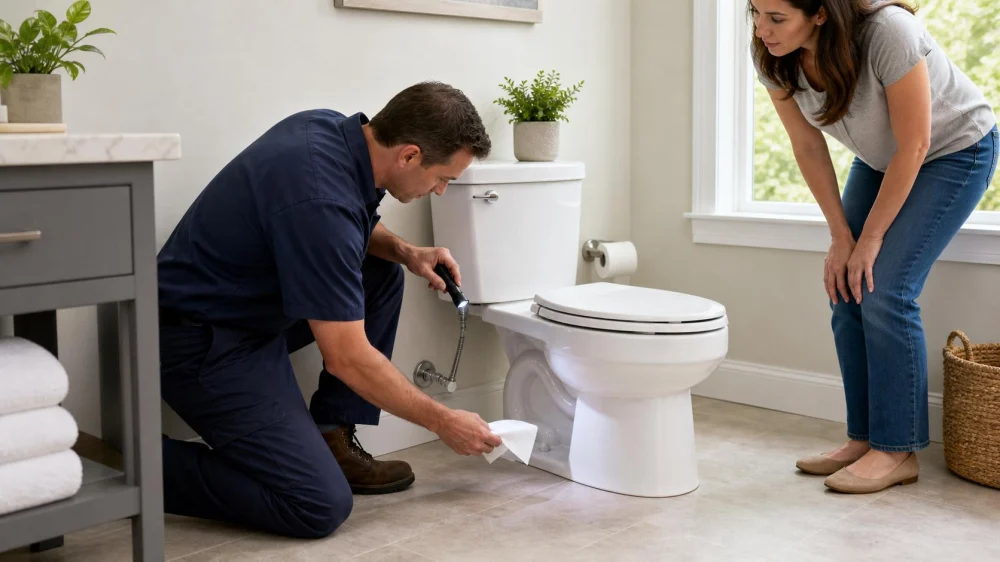
Water Around the Toilet Base: Trace the Source Safely
On this page
- Quick answer
- First response to water on the floor
- Dry and observe before guessing
- Check the supply connection visually
- Look above the base
- Consider condensation and nearby splashes
- Signs the toilet-base seal may be involved
- Protect the floor and rooms below
- What not to tighten, seal, or remove
- When to call a plumber
- Frequently asked questions
- Conclusion and next steps
Quick answer
Stop using the toilet if water appears after flushing, the fixture rocks, sewage odor is present, or the floor feels soft. Dry the toilet and floor completely, then observe where moisture first returns without dismantling anything. Water may come from the supply line, tank hardware, condensation, nearby splashes, or the base seal. Protect the area and arrange a plumber when the source is uncertain or leakage repeats.
Water beside a toilet is not always a failed base seal. Tracing the first wet point helps avoid unnecessary work, but wastewater exposure, hidden damage, and an unstable fixture require prompt professional attention.
Lawrence Plumbing And Heating / lawrence plumbing
708 E Lake Ave, Baltimore, MD 21212, USA
First response to water on the floor
- Keep children and pets away from the wet area.
- Stop using the toilet until you know whether flushing triggers the leak.
- If water is actively flowing and the fixture shutoff moves normally, close it gently; never force a stuck valve.
- Use gloves and absorbent towels to contain water without spreading it.
- Check the ceiling or room below for dripping, staining, or bulging material.
- Photograph the area and note whether the water appears during filling, flushing, or unrelated bathroom use.
Treat water that may contain waste as contaminated. Avoid direct contact, wash hands, and follow suitable cleaning guidance after the plumbing source is controlled.

Stashluk Mechanical Contractors Inc. / stashluk
Franklin TownshipHunterdon CountyNew Jersey
998 Croton Rd, Pittstown, NJ 08867, USA
Dry and observe before guessing
Moisture can travel along porcelain, pipework, grout, and flooring before reaching the visible puddle. Dry the tank, bowl exterior, supply tube, shutoff area, base, and surrounding floor. Place separate dry paper towels beneath likely points without blocking access or touching electrical equipment.
Observe which towel or surface becomes wet first. If a plumber says a controlled test is safe, one person can watch while another flushes once. Stop immediately if water emerges at the base, the toilet moves, the shutoff leaks, or the floor condition worsens.
Check the supply connection visually
The small pipe or flexible connector usually runs from the wall or floor shutoff to the tank. Look for a droplet at either connection, dampness along the line, corrosion, kinks, cracks, or water around the shutoff stem. A supply leak can run down the toilet and appear at the base.
Do not repeatedly turn a corroded valve or tighten a connection by guesswork. Over-tightening can damage the connector, tank fitting, or valve. A plumber can determine whether a washer, connector, valve, or other component needs service.
Look above the base
Inspect the outside of the tank and bowl with a flashlight. Water can originate at tank bolts, the flush-valve area, the tank-to-bowl connection, a hairline crack, or the lid and travel downward. Note whether it appears while the tank refills, only after a flush, or continuously.
Cracked porcelain can fail unpredictably and create sharp edges. Do not sit on, lean against, or attempt to repair a cracked toilet. Stop its use and arrange replacement advice.
Consider condensation and nearby splashes
Cold tank surfaces can collect moisture in a warm, humid bathroom. Condensation is often spread across a larger cool area rather than emerging from one fitting, and it may occur even when the toilet has not just been flushed. Improving ventilation and reducing room humidity may help, but persistent water still deserves inspection.
Also check whether water is escaping a shower door or curtain, dripping from a nearby sink, following grout lines, or coming from cleaning. Dry the room and test one water source at a time. Never assume repeated dampness is harmless condensation without checking for a plumbing leak.
Signs the toilet-base seal may be involved
A seal beneath the toilet connects the fixture outlet to the drain. Water that appears at the base specifically during or just after flushing can indicate a seal, flange, drain, or installation problem. A rocking toilet, recurring sewage odor, staining, or deterioration around the base adds concern.
The absence of visible water does not rule out leakage beneath the flooring. Replacing the seal normally requires shutting off and disconnecting the toilet, lifting it safely, inspecting the flange and floor, and reinstalling it correctly. That work is best handled by someone with the right tools and experience.
Protect the floor and rooms below
Repeated moisture can damage wood, underlayment, fasteners, ceilings, and finishes and may support microbial growth. Keep the toilet out of service, remove standing water, and ventilate the room when safe. Do not direct fans across suspected wastewater contamination.
If flooring is soft, swollen, discolored, loose, or has a persistent odor, tell the plumber before the visit. A restoration, flooring, or building professional may also be needed after the plumbing repair, especially when water reached concealed materials.
What not to tighten, seal, or remove
- Do not caulk over an active leak to hide the water path.
- Do not force the shutoff valve or overtighten supply and tank fittings.
- Do not keep flushing to reproduce a leak that is already evident.
- Do not remove the toilet without planning for weight, contamination, and flange inspection.
- Do not use chemical drain cleaner in a toilet.
- Do not mix disinfectants or cleaning products.
- Do not stand beneath a bulging wet ceiling.
When to call a plumber
Arrange prompt plumbing service when water returns after drying, flushing triggers moisture at the base, the toilet rocks, porcelain is cracked, the supply connector is damaged, the shutoff will not operate normally, or damage appears in the floor or ceiling below. Describe the earliest wet point and timing when booking.
Seek urgent help for uncontrolled flow, sewage backup, water near electrical equipment, a collapsing floor, or a sagging ceiling. Use another bathroom until the affected toilet and surrounding structure are safe.
Frequently asked questions
Does water at the base always mean the wax ring failed?
No. Supply fittings, tank hardware, cracks, condensation, and nearby fixtures can all send water toward the base. Trace from the highest wet point downward.
Can I keep using the toilet if the leak is small?
A small visible puddle can conceal larger damage below. Stop using it when flushing causes the leak or the source is unknown, and arrange an assessment.
Should a toilet move when I sit on it?
No. Movement can stress the seal, flange, fasteners, and supply connection. Avoid use and have the installation and floor checked.
Will caulk around the base fix the leak?
Caulk is not a repair for a failed seal, damaged flange, or leaking component and may hide the evidence needed to find the source.
Conclusion and next steps
Contain the water, stop unnecessary flushing, dry every surface, and identify where moisture first returns. Check the supply, tank, bowl, nearby fixtures, and condensation pattern without dismantling or force-tightening parts. Keep the toilet out of service and call a plumber when leakage repeats, the base moves, wastewater is possible, or the surrounding floor or ceiling shows damage.
 Right on Plumbing, Heating, Air & Home Improvements5.0 (429 reviews)
 2E Plumbing and Well Pump5.0 (37 reviews)
 W.T. Colpitts Plumbing, Heating & Gasfitting0.0 (0 reviews)
 Sav-On Plumbing, Heating, Sewer & Drain Inc.4.0 (15 reviews)
 P.W. Ruane Plumbing, Heating, and Air Conditioning, LLC0.0 (0 reviews)
 Mill Square City Plumbing Solutions5.0 (7 reviews)
 How to Unclog a Drain Using a Plunger
 When Should You Call a Plumber for Installing a New Toilet?
 How to Install a Toilet Tank: Easy Steps for Homeowners
 Ultimate Guide to Maintaining Your Plumbing System
 Expert Advice on Installing a New Toilet: A Step-by-Step Guide
 How to Fix a Frozen Pipe Without Causing Further Damage