
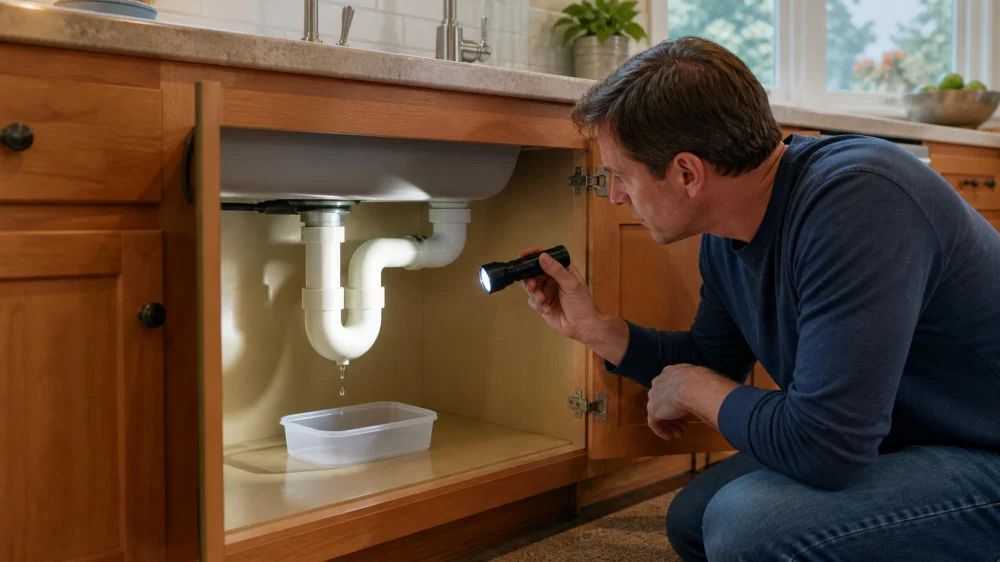
P-Trap Leak Under the Sink: Catch Water, Then Inspect
On this page
- Quick answer
- What the P-trap does
- Immediate steps for a leak
- Dry and locate the source
- Check connections without forcing them
- A controlled test checklist
- When to call a plumber
- Dry the cabinet and limit damage
- Limitations and important notes
- Sources and evidence notes
- Frequently asked questions
- Conclusion and next steps
Quick answer
If the P-trap under a sink leaks, stop using the sink, place a container below the drip, and keep water away from outlets and appliances. Dry the pipes, then use a small amount of clean water to identify the exact joint only if no drain chemical or electrical hazard is present. Do not overtighten plastic nuts or mix incompatible parts. Cracks, corrosion, repeated leaks, sewage odour, or uncertain assembly need a plumber.
This guide is for U.S. homes, including Boone, North Carolina. Sink drains may use plastic or metal tubular fittings, glued pipe, disposal connections, dishwasher hoses, or custom assemblies. Local plumbing requirements vary.
Go Green Plumbing, Heating, Air & Electrical / go green plumbing heating and air
GreensboroGuilford CountyNorth Carolina
300 Pomona Dr, Greensboro, NC 27407, USA
What the P-trap does
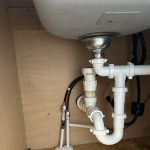
The P-trap is the curved drain section that holds water to help block sewer gases. It connects the sink tailpiece or disposal outlet to the wall drain through fittings designed for the pipe system.
A leak may come from a slip-joint nut, beveled washer, disposal connection, tailpiece, drain basket, cracked bend, corroded metal, blocked drain, misalignment, or a point above the trap that runs downward.
The visible drip is not always the source. Water follows pipe surfaces and cabinet edges, so cleaning and controlled observation are more reliable than tightening every fitting.

Landry Mechanical Inc Plumbing HVAC & Electric / landry mechanical
FraminghamMiddlesex CountyMassachusetts
763 Waverly St unit 32, Framingham, MA 01702, USA
Immediate steps for a leak
- Stop using the sink and dishwasher. A dishwasher may discharge through the same plumbing.
- Place a stable container. Catch dripping water without leaning on the piping.
- Remove stored items. Keep chemicals, paper, and electrical devices away from moisture.
- Check electrical hazards. If water is near a disposal cord, receptacle, appliance, or damaged wiring, keep clear and shut power from a safe dry location.
- Ask about chemicals. If anyone used drain cleaner, do not loosen the trap; tell the plumber exactly what product and when.
- Photograph the assembly. Record the original nut, washer, and pipe positions before touching anything.
Dry and locate the source
With the sink off, wipe the exterior of the tailpiece, trap, wall arm, disposal outlet, dishwasher hose, and cabinet base. Use dry paper towels placed beneath—not wrapped tightly around—individual joints to reveal the first wet point.
If no chemical or electrical hazard exists, add a small measured amount of clean water to the sink while another adult observes from outside the cabinet. Do not fill the basin or run the disposal. Stop as soon as the source appears.
Check separately for a leak from the faucet, supply lines, drain basket, overflow, or countertop. Clean water dripping from above the trap needs a different repair from wastewater escaping a slip joint.
Check connections without forcing them
Many tubular P-traps use slip-joint nuts and beveled washers. The washer orientation, pipe insertion depth, and alignment create the seal; excessive force can distort plastic, crack nuts, or pull the assembly sideways.
If the fitting is designed for hand tightening and you understand the system, support the pipe, align it without strain, and follow the manufacturer’s instructions. Do not apply thread-sealing tape or pipe compound to a slip-joint seal unless the fitting maker requires it.
Metal nuts may be corroded or seized. Glued joints, cracked pipe, wall movement, disposal flanges, and mixed materials require the correct parts and tools. Stop if a pipe turns inside the wall, a fitting deforms, or alignment cannot be achieved without force.
A controlled test checklist
- Remove tools and dry every joint again.
- Keep the catch container and towels in place.
- Run a small amount of cold water with the sink otherwise empty.
- Observe the drain basket, tailpiece, every trap joint, and wall connection.
- Increase flow gradually only if no leak appears.
- Fill and release a small basin volume only when the assembly remains stable and the procedure is appropriate.
- Test the disposal or dishwasher later only under their manufacturer instructions and after the drain is confirmed.
- Recheck after several normal uses; a slow drip may appear later.
When to call a plumber
- The trap or nut is cracked, corroded, deformed, or repeatedly leaks
- The drain is blocked, backs up, or leaks under higher flow
- Drain chemicals, sewage, black water, mould, or strong sewer odour is present
- The wall pipe moves, is damaged, or leaks inside the wall or cabinet
- The assembly is misaligned or uses incompatible sizes or materials
- A disposal, dishwasher, double sink, pump, or vent connection is involved
- Water has reached electrical components, flooring, wall cavities, or lower levels
For Boone-area homes, explain the sink type, pipe material, leak point, chemical use, and water damage when requesting service. Ask whether an electrician or water-damage professional is also needed.
Dry the cabinet and limit damage
After the leak stops, remove wet liners and dry the cabinet with ventilation appropriate to the home. Do not aim heat at plastic pipe, chemicals, or electrical components. Clean wastewater contamination with suitable protective methods.
Inspect swollen particleboard, delaminated cabinet material, stained flooring, musty odour, and moisture below the cabinet. Hidden water may require moisture assessment and prompt remediation.
Leave the catch container temporarily while monitoring, but do not treat it as a repair. A slow leak can overflow when unnoticed.
Limitations and important notes
- Never open a trap that may contain caustic or acidic drain cleaner.
- Do not combine drain products or add a product to a leaking assembly.
- Thread tape does not fix a failed slip-joint washer.
- Overtightening plastic parts can create a delayed crack.
- A dry trap or poor venting can cause sewer odour even without a visible leak and needs proper diagnosis.
Sources and evidence notes
This article reflects general residential plumbing practice: stop flow, manage electrical and chemical hazards, dry and isolate the source, preserve alignment, use correct washers and fittings, and test gradually.
Use fitting manufacturer instructions, local plumbing requirements, and qualified plumbers or electricians. No assembly or repair is approved here.
Frequently asked questions
Should I tighten every P-trap nut?
No. Identify the source first. Overtightening or turning the wrong fitting can cause cracks, misalignment, or wall-pipe damage.
Do slip-joint threads need tape?
Usually the washer makes the seal, not the threads. Follow the fitting maker’s instructions rather than adding tape automatically.
Can I use the dishwasher?
Not until you know whether it drains through the leaking assembly and the repair has been safely tested.
Why does the trap leak only when the sink is full?
Higher flow can expose a loose, misaligned, cracked, or partly blocked connection. Stop using it and inspect or call a plumber.
What if drain cleaner is in the pipe?
Do not loosen the trap. Keep people away and tell the plumber the exact product, amount, and time used.
Conclusion and next steps
Stop sink use, catch the drip, clear the cabinet, and address electrical or chemical hazards first. Dry the assembly and locate the first wet point before touching a fitting. Use only correct model and material instructions, test gradually, and call a plumber for cracks, blockage, corrosion, misalignment, repeated leakage, or hidden damage.
 Larry & Janine's Plumbing & Repairs, Inc.4.0 (24 reviews)
 Lewisville Plumbing Pros4.0 (67 reviews)
 Brian Walsh Plumbing & Heating Inc4.0 (21 reviews)
 Hardy Plumbing | Emergency Plumber, Drain Cleaning, Pipe Repair, Tankless Water Heater Repair and Replacement in Timonium, MD5.0 (50 reviews)
 Byla Plumbing Llc5.0 (9 reviews)
 Master Plumbing & Mechanical, Inc.4.0 (41 reviews)
 How to Fix a Slow Draining Kitchen Sink Permanently and Stop Recurring Clogs
 How to Install a Toilet Tank: Easy Steps for Homeowners
 Why Is My Sewer Line Backing Up? Causes, Signs & Fixes
 Why Is My Toilet Randomly Running at Night? Causes and Solutions Explained
 How to Replace a Broken Drain Vent Pipe - Step-by-Step Guide
 Best Ways to Maintain Your Plumbing System