
Outdoor Faucet Leaks: Find the Cause Before It Gets Worse
On this page
- Quick answer
- Start by locating the leak
- Safe checks homeowners can make
- Common causes by leak pattern
- Special notes for frost-free faucets
- Limit water damage before service
- Outdoor faucet checklist
- Limitations and plumber triggers
- Sources and evidence notes
- Frequently asked questions
- Conclusion and next steps
Quick answer
Remove the hose, turn the outdoor faucet off gently, dry the area, and observe whether water appears at the spout, handle, vacuum breaker, wall opening, or inside the building. A spout drip may involve a washer or valve seat; a handle leak may involve packing; water at the wall or indoors can signal a split or failed connection. Shut off the branch or main supply when damage is possible and call a plumber.
An outdoor faucet leak is uncontrolled water escaping from a hose bibb, sillcock, frost-free hydrant, anti-siphon device, supply connection, or nearby pipe. The visible drip point does not always identify the failed part because water can travel along the pipe or siding.

Stashluk Mechanical Contractors Inc. / stashluk
Franklin TownshipHunterdon CountyNew Jersey
998 Croton Rd, Pittstown, NJ 08867, USA
Start by locating the leak
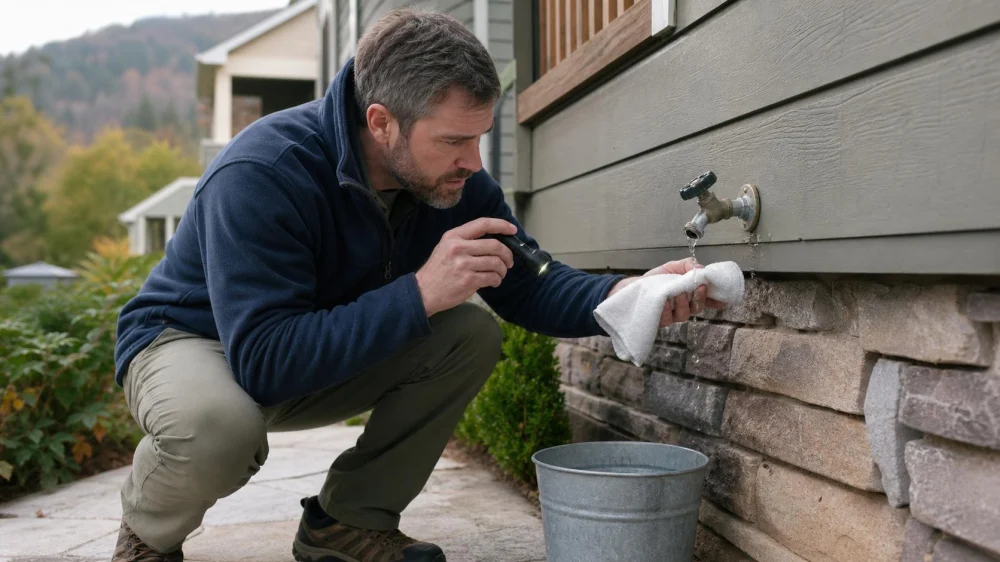
Choose a dry time and clear hoses, splitters, timers, and spray nozzles from the faucet. Accessories can leak independently or hold pressure against the valve. Place a dry towel or container below the fixture and inspect with a flashlight.
- Spout: water drips after the handle is closed.
- Handle or stem: water appears mainly while the faucet is open.
- Vacuum breaker or anti-siphon cap: water sprays or dribbles from the top or vent.
- Wall penetration: siding, masonry, sealant, or the opening becomes wet.
- Indoors: dampness appears in a basement, crawlspace, wall, ceiling, or floor near the supply route.
Photograph the leak while it is active and again after shutoff. Note whether it occurs only with a hose attached, only while flowing, only after closing, or continuously.
Lawrence Plumbing And Heating / lawrence plumbing
708 E Lake Ave, Baltimore, MD 21212, USA
Safe checks homeowners can make
- Remove attachments. Disconnect the hose and accessories so the faucet can drain and be tested alone.
- Close it gently. Turn the handle until flow stops; do not force it with pliers. Excess force can damage the stem or handle.
- Dry and observe. Wipe all surfaces, then watch each potential leak point for several minutes.
- Check inside. If accessible without opening walls or entering a hazardous crawlspace, look for new moisture along the visible pipe.
- Compare the water meter. If the utility and home setup allow, turn off water-using fixtures and observe the leak indicator according to utility guidance. Do not assume one leak is the only source.
- Find the shutoff. Identify the branch valve or main water shutoff before attempting any repair.
Common causes by leak pattern
Drip from the spout when closed
A worn washer, cartridge, damaged valve seat, debris, or freeze damage may prevent sealing. Tightening harder is not a reliable fix and can worsen wear.
Leak around the handle
Packing or a stem seal may leak when pressure reaches the open valve. A small packing-nut adjustment is sometimes described as DIY maintenance, but overtightening can bind the handle or damage parts. Identify the model and shut off water first.
Water from the vacuum breaker
A brief release during operation may be part of some designs, while continuous leakage can indicate debris, damage, incorrect accessory pressure, or a failed device. Do not remove required backflow protection or replace it with an ordinary cap.
Water at the wall
This pattern deserves caution. The faucet body, threaded connection, soldered joint, or pipe may be leaking inside the structure. Stop testing and isolate the supply when water can enter the wall.
Special notes for frost-free faucets
A frost-free sillcock closes farther inside the building, where temperatures are usually warmer. It needs the correct installation slope so water drains outward after shutoff. A hose or closed nozzle left attached can trap water and defeat that drainage.
A split frost-free body may not leak visibly while off. It can release water inside the wall only when the faucet is opened. If indoor dampness appears during use, close the faucet, shut off its supply, and arrange plumbing service.
Boone, North Carolina, can experience freezing conditions, but no outdoor faucet is protected simply by its name. Installation, insulation, hose removal, indoor temperature, and product instructions all matter.
Limit water damage before service
- Stop using the faucet and remove pressure from attached hoses.
- Close the labelled branch shutoff if it operates normally; otherwise use the main shutoff when water is entering the structure.
- Open a suitable lower fixture only if your plumbing instructions call for pressure relief and drainage.
- Keep water away from electrical outlets, panels, appliances, and extension cords.
- Move belongings from the wet area and use towels or a container for minor accessible drips.
- Document the location and timing for the plumber and property insurer if damage is significant.
Do not seal an active leak inside a wall with caulk or expanding foam. Trapping water can hide continuing damage.
Outdoor faucet checklist
- Hose, splitter, timer, and nozzle are removed.
- Spout, handle, vacuum breaker, wall, and indoor pipe path are checked.
- Leak timing is documented with photos or video.
- Branch and main shutoffs are identified and accessible.
- No water is near electrical equipment.
- Frost-free faucet is allowed to drain and is not forced closed.
- Repair parts match the exact faucet model and local requirements.
- A licensed plumber is called for hidden, freeze-related, or structural leaks.
Limitations and plumber triggers
Shut off water and seek prompt plumbing help for water inside a wall, ceiling, basement, or crawlspace; a suddenly high flow; a cracked fixture; a failed shutoff; freeze damage; contaminated water concerns; or a leak near electrical systems.
Use caution with older pipes, corroded fittings, plastic systems requiring special tools, and fixtures soldered directly to supply piping. Twisting an exterior faucet can break a concealed connection.
Local plumbing and backflow requirements apply. A directory listing does not establish availability, licensing, pricing, or suitability; verify the Boone-area professional's current credentials, scope, estimate, and emergency response directly.
Sources and evidence notes
The guidance reflects common plumbing practice: isolate attachments, identify the leak point, avoid force, protect the building, preserve backflow devices, and treat water at the wall as a possible concealed failure.
Use the faucet manufacturer instructions, local plumbing requirements, utility guidance, property-insurance directions, and a qualified licensed plumber as primary sources. Construction and freeze exposure vary by home.
Frequently asked questions
Why does the faucet drip after I turn it off?
A few remaining drops may drain from the body, especially with a frost-free design. Continued dripping can indicate a worn sealing part, debris, pressure issue, or damage.
Can I leave a hose attached in winter?
Usually it is safer to disconnect it so the faucet can drain, especially for frost-free models, but follow the product and home winterisation instructions.
Should I tighten the handle with pliers?
No. Forcing it can strip the handle, damage the stem, or break a concealed connection. Shut off the supply and identify the needed repair.
Why does water leak only when the faucet is on?
Pressure during use may expose a stem, vacuum breaker, body, or wall connection leak. An indoor leak during operation is a strong reason to stop using it and call a plumber.
Can I remove a leaking anti-siphon device?
Do not defeat backflow protection. Identify the approved replacement and local requirements with the manufacturer or a plumber.
Conclusion and next steps
Remove attachments, dry the faucet, locate when and where water appears, and check the accessible indoor side. If water reaches the wall, the faucet may be freeze-damaged, or the shutoff is unreliable, isolate the supply and arrange service. A precise leak description helps a plumber arrive with a better plan.
 Anthony & Sons Plumbing4.0 (117 reviews)
 Drain Medic4.0 (58 reviews)
 Barretta & Sons Inc5.0 (7 reviews)
 All Star Rooter4.0 (47 reviews)
 KenCo Environmental LLC5.0 (30 reviews)
 Roto-Rooter Plumbing & Water Cleanup4.0 (1137 reviews)
 Expert Advice on Understanding Plumbing Codes: Essential Tips for Homeowners and Contractors
 How to Deal with Common Plumbing Problems in Your Kitchen
 What Causes Sump Pump Failure? | Preventive Tips and Maintenance
 How to Fix a Leaking Shower Valve Body: A Step-by-Step Guide
 How to Prevent Common Plumbing Issues in Older Homes
 What Causes Slab Leak Under House?