
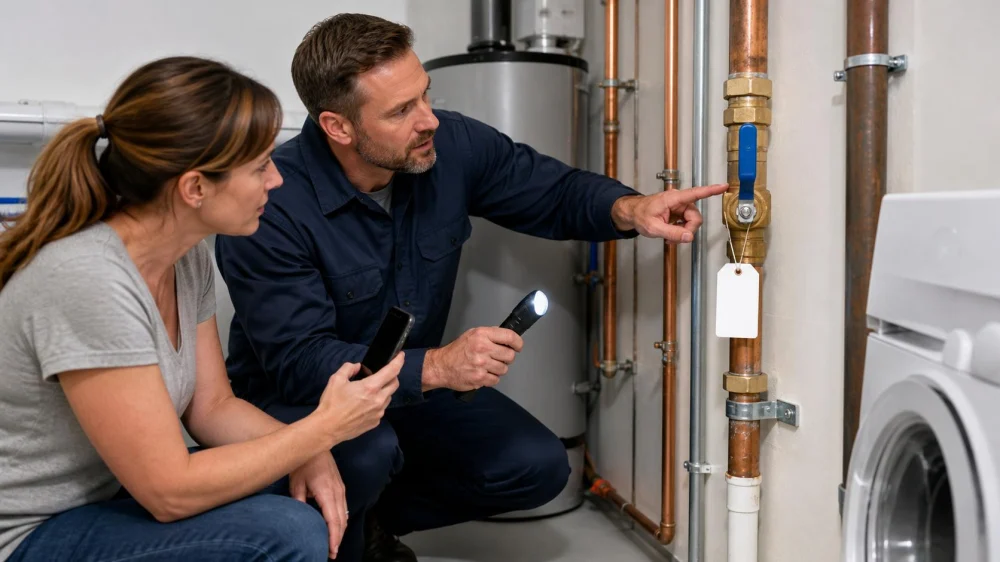
Main Water Shutoff Valve: Find, Label, and Check It Safely
On this page
Quick answer
Locate the building-side main water shutoff before a leak, label it clearly, keep the path open, and ask a plumber to repair any valve that is corroded, leaking, stuck, or unable to close fully. Do not force a valve or operate a street-side utility valve unless your water provider explicitly allows it. Plan any test when someone can watch fixtures and appliances, then teach responsible household members the correct direction and emergency procedure.
Hardy Plumbing / hardy plumbing
Port ClintonSchuylkill CountyPennsylvania
149 Penn St, Port Clinton, PA 19549, USA
Distinguish home and utility valves
The home main shutoff controls water entering the building on the customer’s plumbing. A curb stop or meter valve may belong to the water utility and may require a special tool or authorised crew.
Seattle Public Utilities advises customers generally to use home valves and warns that only certain meter shutoffs may be customer-operated. Your local provider’s rules may differ.
Do not experiment with an underground valve, fire-sprinkler control, irrigation backflow assembly, gas valve, or water-heater relief valve. Identify the correct main water valve with a plumber or utility before an emergency.
Landry Mechanical Inc Plumbing HVAC & Electric / landry mechanical
FraminghamMiddlesex CountyMassachusetts
763 Waverly St unit 32, Framingham, MA 01702, USA
Trace where water enters
In many detached homes, the valve is near where the service line enters the foundation: a basement, crawl space, utility room, garage, or wall facing the street. In warm climates it may be outside. Apartments and multi-unit buildings may use shared systems accessible only to management.
Start at the water meter or visible service entry and trace the cold-water line, without opening sealed boxes or entering unsafe spaces. A main valve often sits before the building’s branch piping, pressure regulator, or distribution manifold.
If several valves are present, do not guess. Ask a licensed plumber, property manager, or water utility to identify ownership and function.
Label and clear access
Attach a durable tag that says the valve controls the home’s main water. Add a simple directional note only after a professional confirms operation. Avoid covering inspection details or tying a tag where it interferes with the handle.
Keep boxes, paint cans, storage, pests, and insulation away. Provide safe lighting and a stable path. Do not require someone to climb over a water heater, touch electrical panels, or enter a confined space during a leak.
Photograph the location and include it in the household emergency plan. Show responsible occupants and a trusted neighbour or property contact.
Inspect without forcing
Look for corrosion, mineral deposits, dampness, damaged handles, bent stems, loose packing nuts, or unsupported pipe. Do not turn a suspect valve merely to see whether it moves.
Older gate valves can seize or fail internally. Ball valves can leak at the stem or become difficult to operate. Excessive force may break the handle, valve, or adjacent piping and create the emergency you hoped to prevent.
Have a plumber inspect or replace a questionable valve. Ask whether a full-port ball valve, access improvement, leak sensor, or automatic shutoff is appropriate and code-compliant.
Plan a controlled test
Test only with the property owner’s permission and a safe plan. Notify occupants, avoid a time when medical equipment or essential processes need water, and confirm how water heaters, boilers, pumps, irrigation, treatment systems, and fire protection may be affected.
Have one person observe the valve and another open a cold faucet. Operate the confirmed main valve slowly according to its design. Flow should stop after stored pressure releases. Watch the valve and nearby joints for leaks.
If it sticks, drips, or fails to stop water, return it only if safe and call a plumber. Never use a pipe extension or hammer for more leverage.
Use it during a leak
For a fixture leak, the working fixture shutoff may control the problem with less disruption. For a burst pipe, uncontrolled supply-line leak, or unknown source, close the main valve if it is safe and you know which valve it is.
Avoid standing water near live electricity. If water reaches electrical equipment or creates shock risk, keep away and call 911 or the electric utility as appropriate. Do not enter a structurally unsafe or contaminated area.
After stopping flow, call a plumber and document damage. Contact the water utility when the home valve fails or the leak is in the service line, following local ownership rules.
Coordinate appliances and reopening
Extended shutoff can affect water heaters, boilers, pumps, filters, softeners, irrigation, ice makers, and fire-sprinkler systems. Follow manufacturer and professional instructions; do not energise a water heater that is not full.
After repair, reopen the main slowly while another person watches the repaired area and open fixtures. Flush air and debris as directed. Check for leaks at the valve, repair, appliances, and upper floors.
If a boil-water or contamination advisory applies, follow the water authority’s instructions before drinking or using the water.
Limitations and important notes
Valve types, utility ownership, plumbing codes, and building systems vary. This guide does not authorise operation of utility, fire-protection, gas, or shared-building valves.
Tenants should know the emergency reporting process and contact property management before testing shared equipment. A shutoff does not repair the leak or remove water already in the structure.
Sources and evidence notes
Fairfax Water recommends locating and marking the main valve and teaching household members how to use it. Seattle guidance recommends ensuring the home valve can close, repairing it before a disaster, and checking utility rules before touching meter valves.
- Fairfax Water: Your Plumbing and Main Water Valve
- Seattle Public Utilities: How to Shut Off Your Water
Frequently asked questions
Where is the main valve usually located?
Often where the service enters the building, but designs vary. Ask a plumber, utility, or property manager to confirm.
Should I turn it every year?
Only through a planned safe test appropriate to the valve and building systems. Do not force an old or suspect valve.
Can I use the street valve?
Only if the local water provider explicitly authorises customer operation of that exact valve.
What if the valve will not close?
Do not add leverage. Call a plumber, and know how to reach the water utility for an emergency shutoff.
Should I close it when travelling?
Discuss extended shutoff and appliance impacts with a plumber, HVAC professional, property manager, and insurers as relevant.
Next steps
Identify the building-side main valve with a qualified source, label and photograph it, clear access, record utility and plumber numbers, and schedule repair if it is suspect. Teach the emergency plan only after the correct valve and procedure are confirmed.
 Northeast Plumbing Service5.0 (111 reviews)
 Lalonde Plumbing5.0 (165 reviews)
 Travisano Plumbing, Heating And Cooling5.0 (71 reviews)
 Epoch Plumbing4.0 (107 reviews)
 Baxter Plumbing & Heating Inc4.0 (68 reviews)
 Green Team Drains2.0 (9 reviews)
 Step-by-Step Guide: How to Install a New Under-Sink Water Filter
 How to Flush Your Water Heater to Improve Its Efficiency
 Understanding Water Heater Drain Valve Leaks and Solutions
 Why Is My Toilet Tank Filling Slowly? Causes and Fixes Explained
 What Causes Preventing Winter Plumbing Issues
 Ceiling Water Stain: Triage It Before the Plumber Arrives