
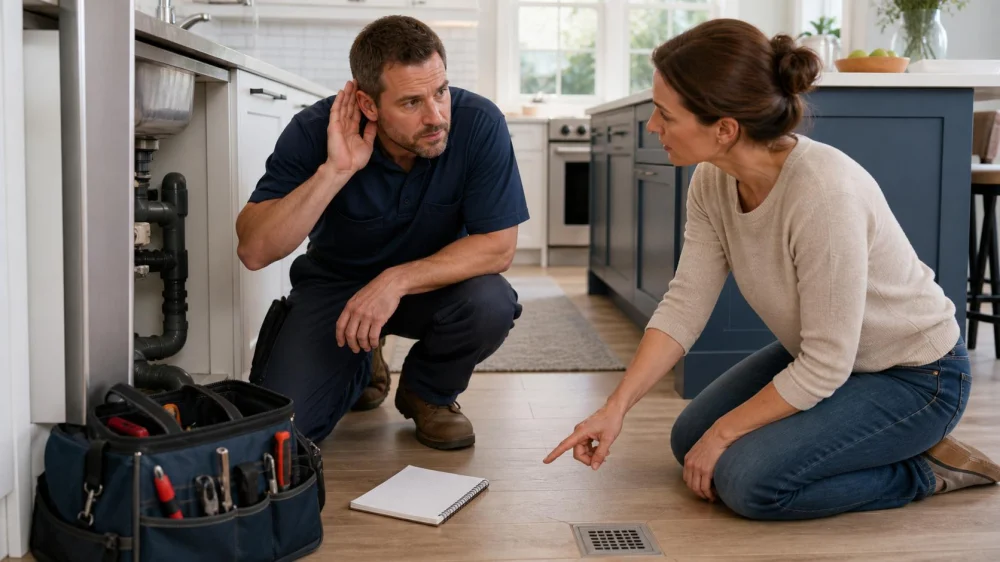
Gurgling Drains: Map the Pattern Before Calling a Plumber
Table of contents
Quick answer
A gurgling drain means air and wastewater are not moving normally. Note which fixture makes the sound, what other fixture was running, whether drainage is slow, and whether water rises elsewhere. Stop using water and call for help if several drains are affected, sewage appears, or a lowest-level drain begins bubbling or backing up.
Sewer Xpress Corp / pipe xpress inc
Eastampton TownshipBurlington CountyNew Jersey
649 Powell Rd, Eastampton Township, NJ 08060, USA
Why drains gurgle
Plumbing drains rely on traps, vents, and open piping to move wastewater while keeping sewer gases out of living areas. A local clog, a blocked or inadequate vent, a building drain obstruction, or a sewer or septic problem can disturb pressure and pull air through a fixture. The sound alone does not locate the problem.
City and state public-health guidance lists gurgling, slow drainage, and wastewater backup as warning signs that deserve attention, especially when multiple fixtures change together.

Warrior Plumbing & Heating / warrior plumbing
4123 Roland Ave, Baltimore, MD 21211, USA
Map the pattern safely
- Identify the listener. Record the sink, tub, floor drain, or toilet where the sound occurs.
- Identify the trigger. Note whether it follows a toilet flush, washing-machine drain, shower, dishwasher, or another fixture.
- Check the scope. Without repeatedly running water, ask whether more than one room or floor is affected.
- Look at the lowest fixtures. From a safe distance, check basement showers and floor drains for rising water.
- Note timing and weather. Record sudden onset, heavy rain, recent plumbing work, or municipal sewer activity.
- Call the right party. Contact a plumber; if neighbours have the same problem or the plumber suspects the public main, contact the local sewer utility.
Backup warning signs
Stop showers, sinks, toilets, dishwashers, and washing machines when wastewater rises, sewage appears, or several fixtures drain poorly at once. Keep people and pets away. Avoid contact with contaminated water, and address electrical hazards only from a safe location through qualified help. Report a suspected public sewer problem using the local utility’s emergency channel.
Avoid risky fixes
- Do not mix or repeatedly add chemical drain cleaners.
- Do not open a cleanout cap casually; backed-up wastewater may be under pressure.
- Do not climb onto a roof to inspect a vent.
- Do not keep flushing to “push” a suspected main-line blockage through.
- Do not use powered drain equipment without training and proper protection.
Tell the plumber about any product already put into the drain so they can plan safe handling.
Limitations
Gurgling can come from fixture-level, branch-line, vent, main-drain, municipal sewer, or septic conditions. A homeowner observation cannot distinguish them reliably. Building layout, local plumbing code, shared piping, and septic design affect diagnosis. Professional inspection may require safe drain access or camera equipment.
FAQ
Is one brief gurgle an emergency?
Not always, but record it and watch for slow drainage, odour, repetition, or effects at other fixtures. Escalate if the pattern expands.
Can I pour water into a dry floor drain?
A dry trap can allow odour. Some utilities advise adding water to routinely maintained floor drains, but do not do this during a suspected backup.
Does gurgling mean the roof vent is blocked?
It is one possibility, not a diagnosis. Do not access the roof yourself; a plumber can assess the system safely.
Who is responsible for the line?
Ownership boundaries vary. A plumber and the local sewer utility can help determine whether the problem is in private piping or the public main.
Sources and evidence notes
- City of Minneapolis: Sewer Safety and Maintenance Tips — traps, vents, gurgling, and backup signs.
- Washington State Department of Health: Signs of Septic System Failure — gurgling and slow-drain warning signs.
- Seattle Public Utilities: Side Sewer Backups — exposure and response guidance.
Next steps
Write down the affected fixture, trigger, timing, and other slow drains. If there is no backup, schedule a plumber before the pattern worsens. If wastewater is rising or multiple drains are involved, stop water use, isolate the area, and call the appropriate emergency plumbing or utility contact.
 Marc Rooter Sewer and Plumbing Services of Long Island3.0 (4 reviews)
 Skilful Plumbing & Water Heater Repair Company0.0 (0 reviews)
 Fumarola Plumbing & Heating5.0 (61 reviews)
 Tim Stocks Plumbing & Heating Inc5.0 (2 reviews)
 Roto-Rooter Plumbing & Water Cleanup of Medford4.0 (127 reviews)
 Trovarelli Plumbing & Heating, LLC0.0 (0 reviews)
 How Often Should You Fix a Garbage Disposal? Maintenance Tips and Recommendations
 How to Fix a Leaking Ice Maker Line Behind Fridge
 How Often Should You Replace Old Pipes? Essential Maintenance Tips
 How to Fix a Broken PVC Water Line: Step-by-Step Guide
 Signs You Need Low Water Pressure: Causes and Solutions
 How to Fix a Leaking Compression Fitting: A Step-by-Step Guide