
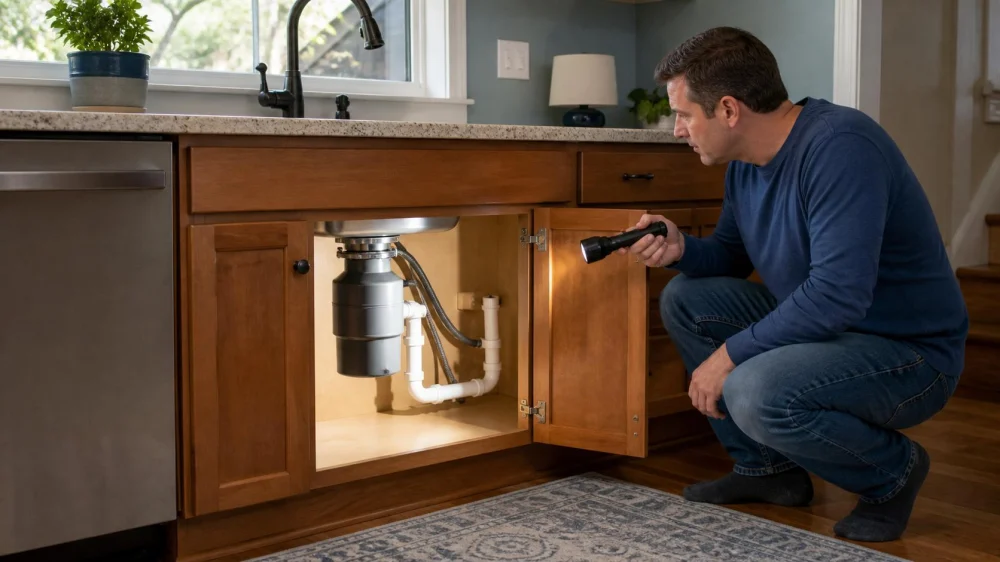
Garbage Disposal Hums but Won’t Spin: Cut Power First
On this page
- Quick answer
- Why a disposal may hum
- Immediate safety steps
- Checks without reaching inside
- Use only the model-specific procedure
- If water is backing up or leaking
- When to call a plumber or electrician
- Reduce future jams
- Limitations and important notes
- Sources and evidence notes
- Frequently asked questions
- Conclusion and next steps
Quick answer
If a garbage disposal hums but does not spin, switch it off immediately and disconnect power at the plug or verified circuit breaker. Do not put a hand, spoon, screwdriver, or other object into the opening. Let the motor cool, identify the exact model, and follow only its approved jam-clearing and reset instructions. Stop for smoke, burning smell, leakage, damaged wiring, or repeated tripping and call a qualified professional.
This guide is for U.S. homes, including Boone, North Carolina. Disposal wiring, switches, air switches, dishwasher connections, septic considerations, and local electrical requirements vary.
Go Green Plumbing, Heating, Air & Electrical / go green plumbing heating and air
GreensboroGuilford CountyNorth Carolina
300 Pomona Dr, Greensboro, NC 27407, USA
Why a disposal may hum
A hum often means the motor is receiving power but the grinding mechanism cannot turn. A hard object, fibrous material, packed food, corrosion, a seized bearing, motor damage, or internal component failure can create that condition.
Continuing to energise a stalled motor can overheat it, trip protection, damage wiring, or create fire risk. Repeatedly flipping the switch is not a diagnostic method.
No sound at all can indicate a different issue, such as a tripped reset, breaker, switch, air-switch, receptacle, cord, or failed motor. Electrical troubleshooting beyond ordinary user checks requires appropriate competence and testing.
JetBlast Inc. Water Blasting Sewer & Drain Cleaning / jet blast drain cleaning
BaltimoreAnne Arundel CountyMaryland
6800 Fort Smallwood Rd, Baltimore, MD 21226, USA
Immediate safety steps
- Turn the wall or air switch off. Do not leave it energised while deciding what to do.
- Disconnect power. Unplug the unit if its plug is accessible without reaching near water, or switch off the verified circuit breaker.
- Prevent accidental restart. Tell household members, label the switch, and keep children away.
- Let the motor cool. Follow the manufacturer’s wait time before using a reset.
- Remove standing hazards. Do not work in pooled water or touch electrical parts with wet hands.
- Find the model information. Use the manual or maker’s current support instructions.
A wall switch in the off position is not a substitute for disconnecting power when inspecting or clearing the unit.
Checks without reaching inside
With power disconnected, use a flashlight from above. Look for a visible loose object near the top, but do not reach in. Never rely on the switch alone.
If the manufacturer permits removal with long-handled pliers or tongs, use the specified method while power remains disconnected. Do not pry against internal parts, force an object that is wedged, or use a hand to confirm it is clear.
Inspect under the sink without touching wiring. Look for water at the sink flange, dishwasher hose, discharge pipe, body seam, cord, switch tubing, or reset area. Do not operate the unit to find a leak.
Use only the model-specific procedure
Some disposals have a manual turning socket on the bottom and use a specific wrench. Others use a different design and should not be forced. Confirm the exact tool, direction, movement, and restart sequence in the manual.
Some models have an overload reset button. Resetting before clearing the jam or allowing the motor to cool can cause immediate retripping. Never tape or hold a reset in place.
After completing an approved procedure, remove every tool, restore the splash guard as designed, stand clear, and restore power only when the area is dry. If the maker calls for a short water flow test, follow it exactly. Turn off immediately for humming, grinding, leak, smoke, odour, or abnormal vibration.
If water is backing up or leaking
Stop using the sink, dishwasher, and connected drain until the source is understood. Place a container under a drip only if it can be done without contacting electricity, hot water, chemicals, or a sagging pipe.
If drain cleaner was used, tell the plumber before service. Never mix chemicals or operate the disposal to move them. Chemical splash can occur when a trap or connection is opened.
For active leakage near wiring or a receptacle, keep clear, shut power from a safe dry location, and call a qualified electrician or plumber. If water is spreading into cabinets or floors, use the appropriate fixture or main shutoff when safe.
When to call a plumber or electrician
- The unit remains jammed after the approved manual procedure
- The breaker, reset, or protective device trips repeatedly
- There is smoke, burning smell, heat, sparking, damaged cord, or wet wiring
- The disposal leaks from its body, mounting, or electrical area
- The sink or dishwasher backs up and the drain path is unclear
- The unit is hardwired and removal or electrical testing is needed
- Internal metal is cracked, severely corroded, or makes abnormal noise
A plumber commonly handles the disposal, mounting, and drain connections. A licensed electrician may be needed for circuit, switch, receptacle, or wiring faults. Some jobs require both.
Reduce future jams
- Use the disposal only for materials allowed by its manufacturer.
- Keep utensils, bottle caps, glass, jewellery, and non-food items away from the opening.
- Feed small amounts rather than packing the chamber.
- Use the water flow and run time specified in the manual.
- Avoid fibrous, expandable, hard, or grease-heavy materials when prohibited.
- Use a sink strainer when the disposal is not operating.
- Never let children operate or reach near the unit.
Limitations and important notes
- A disposal may start unexpectedly if power is not physically disconnected.
- Blades or grinding components may not look sharp but can still cause severe injury.
- Ice, chemicals, broom handles, and other internet remedies are not universal jam-clearing methods.
- Septic-system compatibility and food-waste rules vary by home and locality.
- Replacement must match sink, plumbing, electrical, dishwasher, and local-code requirements.
Sources and evidence notes
This article reflects general appliance, plumbing, and electrical safety practice: stop a stalled motor, disconnect power, keep hands out, use only model-approved turning and reset procedures, and escalate leaks or electrical faults.
Use the exact disposal manual and qualified plumbing or electrical professionals. No model, jam, wiring condition, or repair is declared safe here.
Frequently asked questions
Can I put my hand in if the switch is off?
No. Disconnect power physically and never place a hand in the disposal. Use only manufacturer-approved tools and procedures.
Should I press the reset button first?
Not until power is off, the motor has cooled, and the jam has been addressed as the manual directs. Repeated resetting can worsen the problem.
Can I use a wooden spoon to turn it?
Do not improvise. A spoon can break, damage parts, or place your hand near the opening. Use the approved bottom turning socket or call a professional.
Why does the breaker keep tripping?
A jam, motor fault, wiring issue, moisture, or circuit problem may be present. Leave it off and obtain qualified diagnosis.
Can I run the dishwasher if the disposal is broken?
The dishwasher may drain through the disposal. Ask a plumber before use to avoid backup or leakage.
Conclusion and next steps
A humming disposal is a stop-and-disconnect problem. Cut power, keep hands and improvised tools out, let the motor cool, and use only the exact model’s approved procedure. If it still hums, trips, leaks, smells hot, or shows electrical damage, leave it off and call the appropriate professional.
 AAA-Able Plumbing, Heating, & Drain Cleaning4.0 (70 reviews)
 My Plumber5.0 (12 reviews)
 Bridge Plumbing Sewer & Drain4.0 (18 reviews)
 Pro Plumbing Air & Electric: Plumbing, HVAC, Septic Tank, & Electrical Services4.0 (3713 reviews)
 Aversa Plumbing-Well Pump Services4.0 (51 reviews)
 A-1 Sewer Services4.0 (14 reviews)
 How to Fix a Leaking Faucet: A Complete Guide
 How to Fix a Leaking Drain Pipe in Wall – Step-by-Step Repair Guide
 Why a Sink Gurgles When Another Fixture Drains
 Top Tips for Frozen Pipes and How to Prevent Costly Damage
 When Should You Call a Plumber for Sewer Line Backups?
 Is It Safe to Finding a Reliable Plumber in the U.S.?