
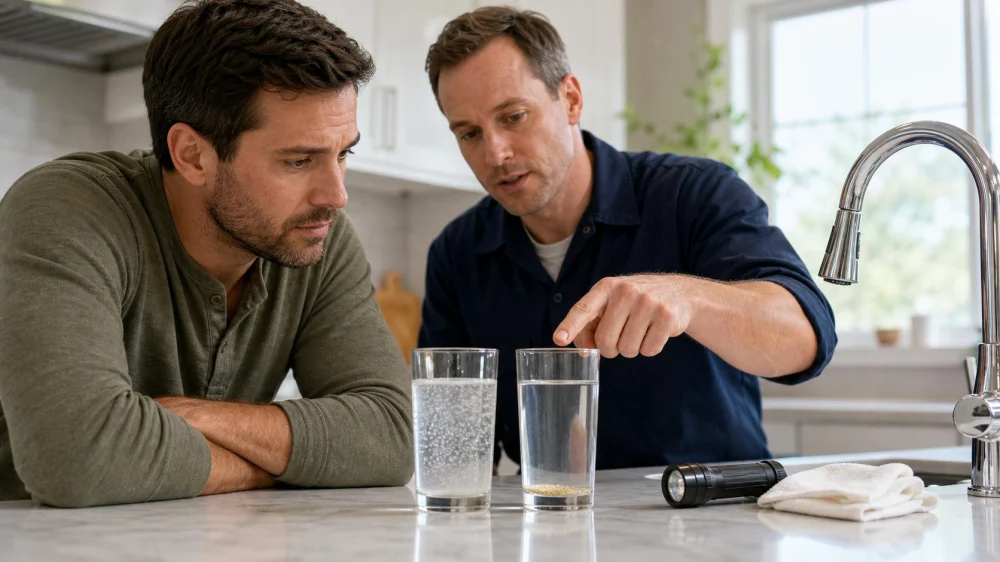
Cloudy Tap Water: Air Bubbles, Sediment, or a Problem?
On this page
- Quick answer
- Start with a clear-glass check
- When tiny air bubbles are likely
- When particles or sediment are present
- Compare hot and cold water
- Check one fixture or the whole home
- Consider recent work and utility changes
- Safe first actions homeowners can take
- What not to do
- When to call for help
- Frequently asked questions
- Conclusion and next steps
Quick answer
Fill a clean clear glass with cold water and let it stand. Cloudiness that clears from the bottom upward within a short time often comes from tiny air bubbles. Material that settles, floats, stains, smells unusual, or remains cloudy needs a different investigation. Compare fixtures and hot versus cold water, note recent plumbing or utility work, and avoid drinking unexplained water until you receive appropriate guidance.
This guide helps US homeowners describe cloudy water; it cannot confirm that water is safe to drink. Follow local water-provider notices and public-health guidance. Private-well owners may need a qualified water test rather than a visual check alone.

Mike the Plumber / mike the plumber
1545 Ocean Ave A3, Bohemia, NY 11716, USA
Start with a clear-glass check
Use a clean, transparent drinking glass with no soap residue. Run the cold tap briefly under normal conditions, collect a sample, place it against a light background, and watch it without stirring. Record whether the cloudiness clears, remains suspended, settles to the bottom, forms a surface film, or leaves color on the glass.
Repeat at another cold-water fixture. A photograph and the time taken to change can help a plumber or water provider understand the pattern. Do not taste the water to identify a cause.

Warrior Plumbing & Heating / warrior plumbing
4123 Roland Ave, Baltimore, MD 21211, USA
When tiny air bubbles are likely
Pressurized water can hold dissolved air. When the water leaves the faucet, tiny bubbles may make it look milky. As bubbles rise and escape, the glass commonly clears from the bottom upward. This can happen after water-main work, a pressure change, cold weather, or plumbing service.
The glass check suggests air but does not prove water quality. Contact the water provider if the condition is widespread, persistent, accompanied by another change, or mentioned in a service notice.
When particles or sediment are present
Visible grains, flakes, fibers, oily-looking films, or material that settles are not the same as air bubbles. Possible sources include disturbed mineral deposits, pipe corrosion, a deteriorating component, water-heater sediment, fixture debris, or material entering from the supply. Appearance alone cannot reliably identify it.
Note the color, size, texture, frequency, and fixtures affected without handling unknown material unnecessarily. Keep a sample only if a plumber, utility, or laboratory tells you how to collect and store it safely.
Compare hot and cold water
At one faucet, collect cold and hot samples separately in clean glasses. If the issue occurs only on the hot side, the water heater or hot-water piping may be relevant. If both sides are affected, the fixture, building supply, or utility source may be involved.
Use ordinary faucet temperatures and avoid scalding water. Do not drain, flush, open, or service a water heater based only on this test. Water heaters involve hot water, electricity or fuel, pressure, and manufacturer-specific procedures.
Check one fixture or the whole home
A problem at one faucet may involve its aerator, supply line, or local branch piping. A change at every fixture points farther upstream. Check several locations, including a tub spout if available, because faucet aerators can trap or release debris.
Ask nearby neighbors whether they see the same change only if doing so is convenient; do not rely on their water as proof that yours is safe. In a rental or multi-unit building, notify the property manager as well as the appropriate service provider.
Consider recent work and utility changes
Write down whether the cloudiness began after:
- a water-main repair, hydrant use, or neighborhood outage;
- work on the home’s shutoff valve or supply piping;
- water-heater installation or maintenance;
- filter, softener, cartridge, or fixture replacement;
- a long period when the property was unoccupied;
- flooding, well service, or loss of well pressure.
This timeline can narrow the inspection, but it should not be used to declare the water safe.
Safe first actions homeowners can take
- Check current notices from the local water provider.
- Document the glass test, affected fixtures, odor, color, and start time.
- Ask the provider whether system flushing is underway and follow its instructions.
- If only one faucet is affected, ask a plumber whether the aerator should be inspected.
- If a treatment device is installed, review its service indicator and contact its provider.
- For a private well, contact a qualified well or water-testing professional for sampling guidance.
Use an alternative water source when an official advisory requires it or when a qualified professional advises you not to use the water.
What not to do
- Do not assume clear-looking water is automatically safe.
- Do not taste, boil, filter, or chemically treat unexplained water as a substitute for correct guidance.
- Do not open pressurized plumbing, a water heater, or a treatment tank.
- Do not mix cleaning chemicals or pour them into the plumbing.
- Do not remove a utility meter, backflow device, or sealed component.
- Do not ignore an official boil-water, do-not-drink, or do-not-use notice.
Boiling is useful only for specific biological risks and may concentrate some contaminants. Follow the exact notice issued for your area.
When to call for help
Contact the water provider for changes affecting several fixtures, neighbors, or the cold-water supply, especially after utility work. Call a licensed plumber when the issue appears confined to the property, follows plumbing service, recurs without a utility explanation, or involves a water heater, treatment system, corroded piping, or pressure problem.
Stop using the water and seek appropriate official guidance if it has a chemical or sewage-like odor, oily film, unusual color, visible contamination, or if illness is suspected. Report loss of pressure, a cross-connection concern, flooding near a well, or a public advisory promptly.
Frequently asked questions
Why does the glass clear from the bottom first?
Air bubbles rise toward the surface, so the lower portion can become clear before the top. Settling sediment generally moves downward instead.
Can a dirty faucet aerator make water look cloudy?
An aerator can add air or release trapped debris. Comparing another fixture or a tub spout can help, but follow safe cleaning guidance and replace damaged parts.
Is cloudy hot water always a water-heater problem?
No. Hot-side-only cloudiness makes the heater or hot piping relevant, but a professional may need to inspect the system and consider water chemistry.
Should I buy a home water test kit?
A test must match the suspected issue and use correct sampling. Ask the water provider, health authority, well professional, or accredited laboratory which analysis is appropriate.
Conclusion and next steps
Use a clear glass to distinguish rising bubbles from persistent material, then map whether the change affects hot water, cold water, one fixture, or the whole home. Check official notices and document recent work. If the cause or safety remains uncertain, pause drinking use and contact the water provider, a licensed plumber, or a qualified water-testing professional.
 Right on Plumbing, Heating, Air & Home Improvements5.0 (429 reviews)
 2E Plumbing and Well Pump5.0 (37 reviews)
 W.T. Colpitts Plumbing, Heating & Gasfitting0.0 (0 reviews)
 Sav-On Plumbing, Heating, Sewer & Drain Inc.4.0 (15 reviews)
 P.W. Ruane Plumbing, Heating, and Air Conditioning, LLC0.0 (0 reviews)
 Mill Square City Plumbing Solutions5.0 (7 reviews)
 How to Unclog a Drain Using a Plunger
 When Should You Call a Plumber for Installing a New Toilet?
 How to Install a Toilet Tank: Easy Steps for Homeowners
 Ultimate Guide to Maintaining Your Plumbing System
 Expert Advice on Installing a New Toilet: A Step-by-Step Guide
 How to Fix a Frozen Pipe Without Causing Further Damage