
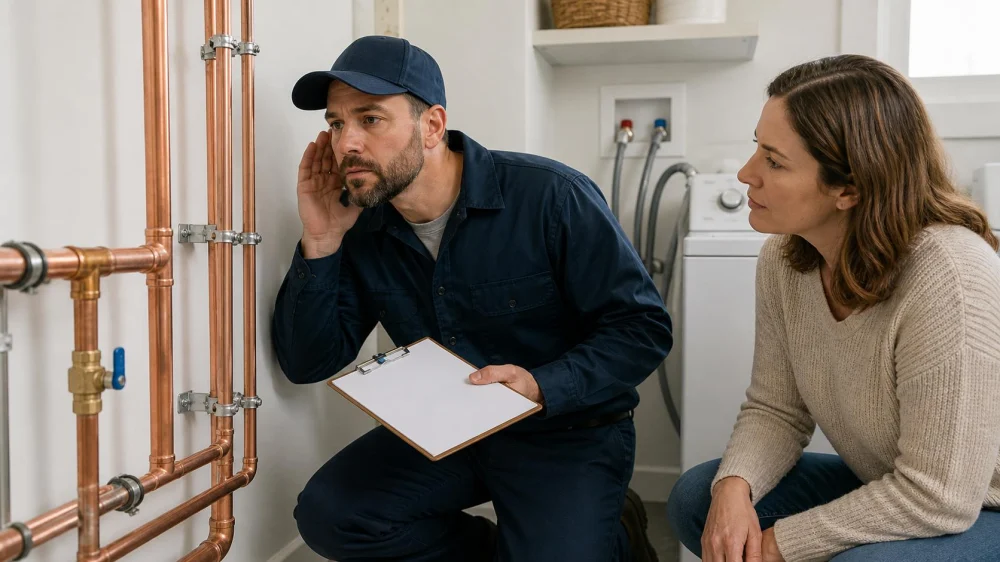
Water Hammer Noise: What to Record Before Calling a Plumber
On this page
Quick answer
If pipes bang when a faucet, washing machine, dishwasher, toilet, or irrigation valve stops, note the exact fixture, time, cycle, water temperature, frequency, and where the sound seems strongest. Check only visible pipes for loose supports, movement, or leakage without touching hot or electrical equipment. Do not adjust a pressure regulator, add arrestors, open walls, or force valves by guesswork. Call a qualified plumber for repeated hammer, leaks, high pressure concerns, or movement.
Water hammer is a pressure wave created when moving water changes speed or stops suddenly. Similar banging can also come from thermal expansion, loose pipes, failing valves, pumps, or equipment.
Hardy Plumbing / hardy plumbing
Port ClintonSchuylkill CountyPennsylvania
149 Penn St, Port Clinton, PA 19549, USA
What water hammer means
A sharp single bang immediately after a fast-closing valve suggests one pattern. Repeated knocking, ticking during heating, vibration while water flows, or noise with no fixture use may have different causes. The sound location can be misleading because pipes carry vibration through the building.
Sewer Xpress Corp / pipe xpress inc
Eastampton TownshipBurlington CountyNew Jersey
649 Powell Rd, Eastampton Township, NJ 08060, USA
Record the trigger
- fixture or appliance operating;
- whether water starts, runs, or stops;
- hot, cold, or mixed water;
- one bang, repeated knocks, hum, or rattle;
- time of day and other simultaneous water use;
- recent plumbing, appliance, meter, or pressure work;
- visible pipe movement, leaks, or pressure changes.
Record audio or video only from a safe dry location. Do not hold a phone near moving machinery or open electrical panels.
Safe observations
- Stand clear of wet floors and energized equipment.
- Operate one ordinary fixture at a time if no leak or hazard is present.
- Observe accessible pipes without grabbing them.
- Look for missing or loose supports, wall contact, stains, and drips.
- Check whether the noise follows an appliance valve rather than a hand faucet.
- Stop the test if banging intensifies or leakage appears.
What not to do
- do not close the main valve repeatedly as an experiment;
- do not change regulator settings without measuring and understanding the system;
- do not cap relief, expansion, or drain components;
- do not add an arrestor in a random location;
- do not cut walls or tighten hidden pipes blindly;
- do not continue using a leaking or violently moving appliance connection.
When to call
Arrange inspection for recurring noise, visibly moving pipes, high or fluctuating pressure, leaks, recent valve replacement, a new fast-closing appliance, failed supports, water-heater expansion concerns, or noise affecting multiple fixtures. For a burst pipe or rapid leak, shut water off only if safe and use emergency service.
In Boone, North Carolina, choose a qualified local plumber who can check static and dynamic pressure, valve behaviour, supports, expansion control, and appropriate arrestor placement under local requirements.
Important notes
This is general plumbing information, not diagnosis or code guidance. Municipal pressure, wells, pumps, heaters, regulators, backflow devices, and piping materials differ. Hot water and pressurised systems can cause injury.
Evidence notes
The approach reflects common plumbing diagnosis: reproduce the trigger safely, distinguish timing and sound pattern, measure pressure, inspect supports and valves, and design a cause-specific correction. A qualified plumber is the primary source for a building.
FAQ
Is every pipe bang water hammer?
No. Expansion, loose supports, pumps, and valves can make similar sounds.
Can high pressure cause hammer?
It can contribute, but pressure must be measured and the full system assessed.
Will an arrestor always fix it?
No. Location, sizing, cause, and valve type matter.
Is ticking from hot pipes the same?
Often it reflects expansion against framing, but inspection may be needed.
Can water hammer damage plumbing?
Repeated pressure and movement can stress components, so persistent hammer should be evaluated.
Next steps
Write down the triggering fixture, timing, sound pattern, temperature, and recent changes. Photograph only accessible movement or leaks. Stop using any connection that leaks or moves violently and give the record to a qualified local plumber.
 G C Plumbing & Heating Inc3.0 (17 reviews)
 Benzinger Plumbing & Heating4.0 (8 reviews)
 Pann Home Services & Remodeling4.0 (260 reviews)
 JCP Plumbing & Heating Inc4.0 (5 reviews)
 Cameron Plumbing & Heating Mechanical Contractors LLC4.0 (48 reviews)
 A P Daino Plumbing & Heating0.0 (0 reviews)
 How Long Does It Take to Install a New Toilet?
 How to Fix a Leaking Outdoor Water Line: Step-by-Step Repair Guide
 Why Is My Toilet Randomly Running at Night? Causes and Solutions Explained
 Ultimate Guide to a Running Toilet | PlumberNear
 What to Do If Clogged Drains: Expert Solutions for Unclogging Your Pipes
 Why Is My Washing Machine Drain Backing Up? Causes and Fixes