
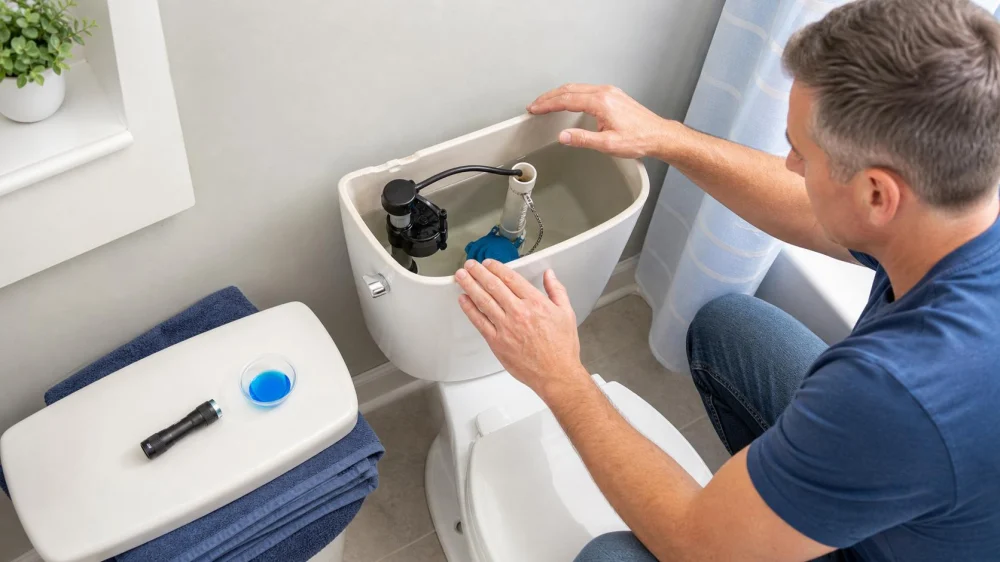
Toilet Runs Between Flushes: Find the Cause Safely
Table of contents
Quick answer
If a toilet briefly refills even though nobody flushed it, water is often slipping from the tank into the bowl and triggering the fill valve. Start by watching the tank water level, then test the flapper with food coloring. Also check for a tangled chain, a float that rubs the tank, or water entering the overflow tube. Do not force an old shutoff valve or disturb leaking connections.
Hardy Plumbing / hardy plumbing
Port ClintonSchuylkill CountyPennsylvania
149 Penn St, Port Clinton, PA 19549, USA
Listen and observe first
An intermittent toilet run is sometimes called a phantom flush, but the toilet is not actually flushing itself. The tank is losing enough water that the fill valve opens to restore the preset level. A short refill every few minutes or every few hours points toward a slow leak; a steady hiss suggests a larger leak or a fill valve that never shuts completely.
- Ask everyone in the home not to use the toilet during the test.
- Dry the floor around the toilet so a new drip will be easy to see.
- Note whether the sound comes from inside the tank, the supply connection, or a nearby fixture.
- Wait through at least one normal refill cycle before touching any parts.
Look outside the tank before opening it. Water on the floor, moisture below the tank bolts, a wet supply hose, a rocking bowl, or a hairline crack changes the job from a simple internal inspection to a leak that deserves prompt professional attention.
Lawrence Plumbing And Heating / lawrence plumbing
708 E Lake Ave, Baltimore, MD 21212, USA
Protect the shutoff and tank lid
Toilet tank lids are heavy, brittle, and difficult to replace. Lift with both hands and place the lid flat on a folded towel away from the edge of the counter or tub. Keep tools and phones where they cannot fall into the porcelain tank.
Find the small shutoff valve on the wall or floor behind the toilet, but do not assume it will operate smoothly. If you need to stop the supply, turn the handle gently clockwise only while it moves freely. Stop if the valve is stuck, badly corroded, begins dripping around the stem, or the supply tube shifts. Forcing a deteriorated valve can turn a tank repair into an uncontrolled household leak. Know where the home's main water shutoff is before attempting any replacement.
Run a food-color test
A dye test can show whether tank water is passing into the bowl without a flush. Use a small amount of ordinary food coloring only if the toilet manufacturer does not prohibit it, and avoid products that may stain porous or damaged surfaces.
- Let the tank finish filling, then wait until the water is completely still.
- Add several drops of food coloring to the tank water, away from the sides.
- Do not flush. Close the bathroom door or leave a reminder so nobody interrupts the test.
- After about 20 to 30 minutes, inspect the bowl. Colored water in the bowl indicates a tank-to-bowl leak.
- Flush after the observation period to clear the dye.
If no color appears but the fill valve still cycles, extend the observation period and watch the tank waterline. A leak can be very slow. Also confirm that water is not splashing or siphoning into the overflow tube.
Check the flapper and chain
The flapper or canister seal closes the opening between the tank and bowl. Mineral deposits, warping, age, or misalignment can prevent a complete seal. With the tank full and still, look for ripples near the flush-valve opening. Gently press the flapper closed with a clean tool or gloved hand; if the refill cycles stop, the seal or its seating surface is a likely cause.
- Check that the flapper sits evenly and matches the toilet's flush-valve design.
- Look for a brittle, swollen, cracked, or wavy rubber edge.
- Remove loose mineral grit with a soft cloth; do not scrape porcelain or plastic with metal.
- Make sure the lift chain is not caught under the flapper, wrapped around the lever, or pulled tight.
- Leave the small amount of chain slack specified by the toilet or flapper manufacturer so the seal can close without the chain tangling.
A universal-looking part may not fit every toilet. Before buying a seal, note the toilet model, flush-valve style, and the shape and attachment points of the existing part. Follow the replacement instructions supplied with the compatible component.
Check the fill valve and water level
The fill valve should shut off when the tank reaches its intended waterline. Many tanks have a molded or printed mark; otherwise consult the toilet manual. The water must not continuously spill into the open overflow tube.
- Flush once and watch the float rise without touching it.
- Confirm the float does not rub the tank wall, catch on the flush lever, or snag the chain.
- When filling stops, compare the water level with the manufacturer's mark and the top of the overflow tube.
- Check that the small refill tube is secured in the correct position. It should not be pushed so far down the overflow tube that it can encourage siphoning.
- If the valve continues to hiss after the float reaches its stop point, follow the manufacturer's adjustment procedure or arrange replacement.
Do not bend, cut, or improvise a modern fill-valve assembly. Adjustment methods differ among models, and an incorrect setting can cause weak flushing, wasted water, or continuous overflow.
Know your repair boundaries
Cleaning a sealing surface, untangling a chain, or installing a clearly compatible flapper is often a manageable homeowner task. Stop and call a local plumber when the diagnosis involves the supply line, tank bolts, a leaking shutoff, cracked porcelain, an unfamiliar pressure-assisted tank, or removal of the toilet.
Also get help when the toilet keeps running after a compatible seal and correct water-level adjustment, when several fixtures show unusual behavior, or when you cannot confidently isolate the water. In Boone and other areas with seasonal cold weather, unexplained dampness near an exterior wall can have a source beyond the toilet itself.
Final checklist
- The floor, supply connection, tank bolts, and porcelain are dry.
- The tank lid is stored safely while work is underway.
- The flapper or canister seal closes flat and is not obstructed.
- The chain has manufacturer-appropriate slack and cannot tangle.
- The float moves freely and the fill valve shuts off completely.
- The water stops at the correct tank mark and does not enter the overflow tube continuously.
- The toilet remains quiet through an extended no-use observation period.
- A final test flush clears any food coloring and confirms normal operation.
Limitations
This guide covers common gravity-fed residential toilets and visual checks that do not require dismantling supply plumbing. Dual-flush, concealed-cistern, pressure-assisted, and smart toilets may use different seals and service procedures. Component names, water-level settings, and replacement steps vary by manufacturer. A dye test can confirm tank-to-bowl leakage, but it does not by itself identify every defective part.
Frequently asked questions
Why does my toilet run for a few seconds at random?
The tank may be slowly losing water through the flush-valve seal. When the level falls far enough, the fill valve opens briefly. A food-color test and a close look at the flapper or canister seal can help confirm this pattern.
Can I just jiggle the handle?
Jiggling may temporarily free a chain or let the flapper settle, but it does not correct a worn seal, incorrect chain length, or misaligned lever. Inspect the parts rather than treating the handle movement as a lasting repair.
Should I put a cleaning tablet in the tank?
Use only products approved by the toilet and component manufacturers. Some in-tank chemicals can shorten the life of rubber seals or other parts. Bowl-applied cleaning methods avoid prolonged exposure of tank components.
How long should I wait during a dye test?
Twenty to 30 minutes is a useful first check for a noticeable leak. A very slow leak may require longer observation. Do not flush during the test, and flush promptly afterward to remove the coloring.
When is an intermittently running toilet urgent?
Act promptly if water appears outside the fixture, the shutoff or supply connection leaks, porcelain is cracked, the toilet rocks, or the fill valve will not stop. Shut off water only if the valve operates safely; otherwise use the main shutoff or call a plumber.
Next steps
Record the toilet model, what you heard, dye-test results, waterline behavior, and any visible wear. Those details help you select the correct part or give a plumber a useful starting point. After any adjustment, observe the toilet during several hours of normal use and recheck the floor and connections for moisture.
 JV Plumbing4.0 (38 reviews)
 Learjet Plumbing5.0 (90 reviews)
 Make It Flow5.0 (91 reviews)
 Mark Kaczala Plumbing & Heating Inc5.0 (11 reviews)
 Whittaker Water Tech LLC5.0 (227 reviews)
 G&C Plumbing & Heating5.0 (485 reviews)
 Best Ways to Maintaining Your Plumbing System – Expert Tips for U.S. Homeowners
 Avoid These Mistakes When Finding a Reliable Plumber
 Best Ways to Fix a Broken Water Heater: Common Problems and Solutions
 How to Unclog a Bathtub Drain Safely and Effectively
 Expert Advice on a Broken Water Heater
 What Causes Preventing Winter Plumbing Issues