
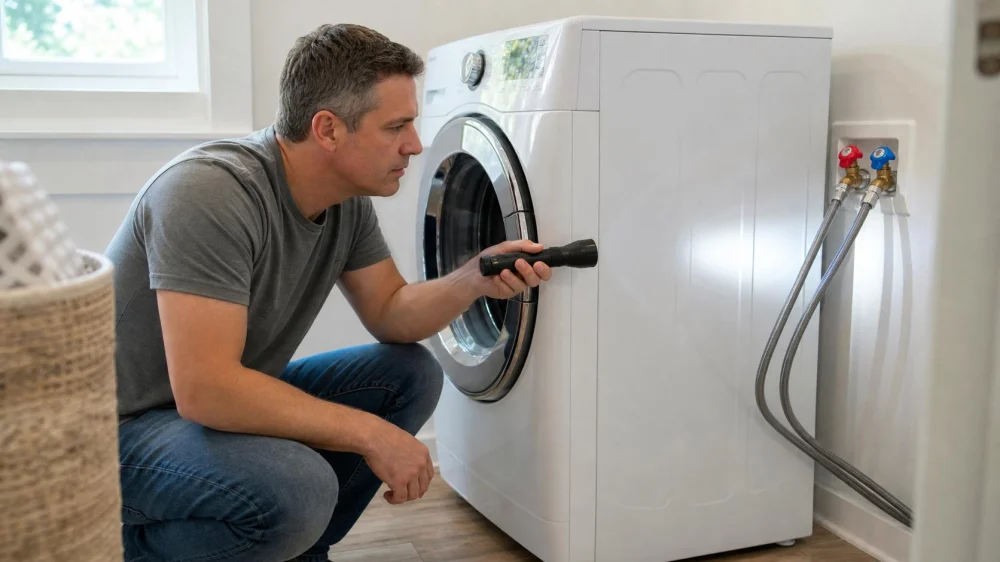
How to Check Washing Machine Hoses Before They Leak
On this page
- Quick answer
- Locate hoses and shutoffs
- Inspect without disturbing connections
- Run a controlled observation
- Know when replacement needs a plumber
- Reduce future leak damage
- Hose inspection checklist
- Limitations and important notes
- Frequently asked questions
- Sources and evidence notes
- Inspect before the next load
Quick answer
Inspect washing-machine supply hoses for bulges, cracks, rust, dampness, abrasion, tight bends, and stressed connections. Know which valves stop hot and cold water before a leak occurs. Do not pull out a heavy machine or tighten fittings while water is flowing. Replace questionable hoses according to appliance and hose guidance, and call a plumber when valves, connections, access, or corrosion are unsafe.
This guide is for homeowners in the United States, including Boone, North Carolina. Plumbing layouts and local requirements vary. Follow the washer, hose, and valve manufacturers' instructions.

coastal & son, llc / aj appliance toms river nj
Toms RiverOcean CountyNew Jersey
1106 Verdant Rd, Toms River, NJ 08753, USA
Locate hoses and shutoffs
Washing machines usually have hot and cold supply hoses connected to valves and a separate drain hose. Confirm which is which without disconnecting anything. Find the individual shutoff valves and the home's main water shutoff.
Access must be safe. Do not lean over a running machine, crawl behind it, or pull it across flooring without adequate clearance and help. If valves are hidden or the appliance is stacked, use a qualified professional.
Landry Mechanical Inc Plumbing HVAC & Electric / landry mechanical
FraminghamMiddlesex CountyMassachusetts
763 Waverly St unit 32, Framingham, MA 01702, USA
Inspect without disturbing connections
With the machine off and the area dry, use a flashlight to check as much hose length as is safely visible.
- bulges, bubbles, cracks, fraying, or flattening;
- sharp kinks and bends at the fittings;
- rubbing against a wall, cabinet, or sharp edge;
- rust, mineral deposits, green staining, or dampness;
- corroded valves or fittings;
- loose drain-hose support or signs of overflow; and
- water marks on the wall, floor, tray, or baseboard.
Do not squeeze a bulging hose, scrape corrosion, or twist a fitting to test it. A weakened part can fail when disturbed.
Run a controlled observation
If no defect is visible and normal use is appropriate, run a short cycle while remaining nearby. Observe connections as the washer fills, drains, and spins. Keep hands, tools, and clothing away from the appliance and hoses.
Stop the cycle and shut water off if you see spraying, dripping, swelling, or rapidly spreading moisture. Use the main shutoff if local valves do not operate safely. Protect people from electricity and slippery floors; do not touch powered equipment while standing in water.
Know when replacement needs a plumber
Replace a hose when its instructions require it or when damage, leakage, corrosion, or unknown age makes reliability uncertain. Use a type, length, pressure rating, and connection approved for the appliance and installation.
Call a plumber when a valve will not close, a fitting is corroded or seized, the wall box leaks, threads are damaged, access requires moving a heavy or stacked appliance, or local requirements are unclear. Appliance service may be appropriate when the leak originates inside the washer.
Do not add tape, sealant, clamps, or improvised patches to a failing supply hose.
Reduce future leak damage
Keep hoses free of crushing and abrasion, maintain clearance, and avoid storing objects against them. Consider an appropriate drain pan or leak-detection system where compatible and properly installed.
Know how to close valves and check them periodically according to professional guidance. Do not force a stiff valve. Avoid running the washer when no responsible person can respond to a leak.
Hose inspection checklist
- Find both washer valves and the main shutoff.
- Keep the machine off for the dry inspection.
- Check hoses, fittings, valves, drain support, floor, and wall.
- Do not disturb bulges or corrosion.
- Observe one normal cycle only when safe.
- Stop water promptly after any active leak.
- Use approved replacement parts and installation.
- Escalate unsafe access, valves, or electrical exposure.
Limitations and important notes
- A braided exterior does not prove the inner hose is undamaged.
- Flood-prevention devices require correct selection, installation, power, and maintenance.
- Well systems, high pressure, hard water, freezing risk, and shared buildings can change the plan.
- Never rely on a floor drain to make an active leak acceptable.
- For major flooding or electrical danger, leave the area and contact appropriate emergency help.
Frequently asked questions
How often should washing-machine hoses be replaced?
Follow the appliance and hose manufacturer guidance and replace earlier for damage, leakage, corrosion, or uncertain history. There is no universal interval for every product.
Are braided hoses leak-proof?
No. They can still fail at the inner tube, fitting, crimp, or connection.
Should washer valves stay off between loads?
Follow system and manufacturer guidance. If operating valves, do not force them and confirm household members know the routine.
Can I tighten a dripping fitting?
Overtightening can damage threads or washers. Shut water off safely and obtain the correct repair guidance.
Who repairs an internal washer leak?
An appliance technician may handle internal components; a plumber handles supply valves and building plumbing. Ask when the source is unclear.
Sources and evidence notes
The checks reflect common plumbing and appliance practice: know shutoffs, inspect for deterioration, avoid disturbing weakened fittings, observe under controlled conditions, and use approved parts. Manufacturer instructions and qualified local professionals provide installation-specific requirements.
Inspect before the next load
With the washer off, locate both valves and photograph the visible hose route. Check for dampness, bulges, abrasion, corrosion, and tight bends. If the area is dry and sound, observe the next cycle; if anything is questionable, stop and arrange the appropriate plumbing or appliance service.
 WNW & Sons Plumbing & Heating5.0 (17 reviews)
 TJB Plumbing LLC4.0 (17 reviews)
 the patriot plumber3.0 (2 reviews)
 RIC Plumbing, Inc4.0 (25 reviews)
 Kenmar plumbing and heating5.0 (3 reviews)
 Miller's Plumbing & Heating4.0 (60 reviews)
 How to Prevent Your Pipes from Freezing During Winter
 How to Prevent and Fix Winter Plumbing Issues
 How Long Does It Take to Replace Old Pipes?
 What Causes Water Damage in Your Bathroom? Discover the Real Issues
 Common Reasons Your Water Heater Is Not Igniting and How to Fix It
 How to Install a Shower Pan Liner Correctly for a Leak-Free Bathroom