
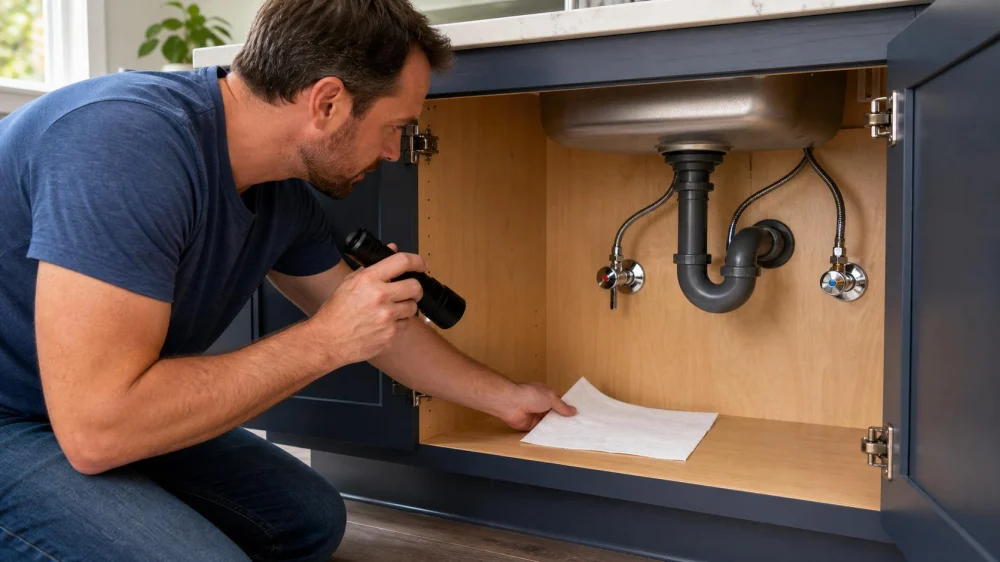
How to Check Under-Sink Supply Lines for Slow Leaks
On this page
Quick answer
Empty the cabinet, dry every surface, and inspect supply valves, flexible lines, faucet connections, filter tubing, and the cabinet floor with a flashlight. Wrap a dry paper towel around one connection at a time, then run hot and cold water while watching safely. Shut off water and call a plumber for active spraying, corroded valves, damaged lines, persistent moisture, cabinet damage, mould, or an uncertain source.
This guide is for U.S. homeowners, including Boone, North Carolina. Plumbing, filtration, disposal, dishwasher, and electrical layouts vary. Follow product and local professional guidance.
Lawrence Plumbing And Heating / lawrence plumbing
708 E Lake Ave, Baltimore, MD 21212, USA
Create a dry baseline
Remove stored items and check them for moisture. Photograph staining before cleaning. Dry the cabinet floor, pipe surfaces, valves, and fittings completely so new water is visible.
Use a flashlight rather than reaching blindly. Keep cleaners, electrical devices, and extension cords out of the cabinet. If standing water is near a receptacle, disposal, dishwasher connection, or wiring, do not touch equipment; isolate power and water only when safe and obtain help.

coastal & son, llc / aj appliance toms river nj
Toms RiverOcean CountyNew Jersey
1106 Verdant Rd, Toms River, NJ 08753, USA
Inspect each connection
- hot and cold shutoff valves and their stems;
- flexible supply-line fittings at valves and faucet;
- faucet body and pull-out hose connections;
- filter, dispenser, refrigerator, or instant-hot tubing;
- dishwasher supply when routed through the cabinet;
- pipe penetrations and the back wall; and
- cabinet seams, swelling, peeling, and staining.
Look for beads of water, white or green mineral deposits, rust, dark staining, bulges, cracks, and kinked lines. Do not scrape corrosion, twist a fitting, or operate a valve that appears fragile.
Test under controlled use
Place dry paper towel around a single connection without pressing it into wiring or moving parts. Turn on cold water briefly, then hot, while another adult observes below. Test the sprayer and faucet movement because a leak may occur only when a hose changes position.
Check again after water stops; slow seepage can appear later. Label photos by location rather than leaving paper wrapped permanently around fittings, where it can hide future moisture.
Stop immediately for spraying, rapid dripping, swelling hose, or water spreading toward electricity. Use the fixture shutoffs or main shutoff only when they operate safely.
Separate supply, drain, and splash sources
A supply leak can occur even when the sink is not draining. A drain leak usually appears while water passes through the basin, trap, disposal, or dishwasher discharge. Splash may travel around the faucet base or counter seam.
Test one function at a time: faucet supply, basin drain, filled-basin release, sprayer, dishwasher, and filter. Do not run a disposal dry or place hands in it. Food waste and drain-cleaning chemicals require separate safety precautions.
Water can travel along a pipe before dripping, so the wettest spot is not always the origin.
Know when to call a plumber
Call a plumber for corroded or seized valves, damaged supply lines, recurring dampness, hidden-wall moisture, leaking filter assemblies you cannot isolate, or any repair requiring disassembly beyond your training.
Cabinet swelling, soft flooring, odour, visible mould, pest damage, or water entering the room below may require additional building, drying, or remediation professionals. Do not cover damage with a liner before the source is fixed and the area is dry.
Slow-leak checklist
- Empty and photograph the cabinet.
- Dry all surfaces and create a clear baseline.
- Locate fixture and main shutoffs.
- Inspect valves, lines, faucet, filters, drains, walls, and floor.
- Test one connection and one function at a time.
- Keep water away from electrical equipment.
- Stop for active leakage or fragile corrosion.
- Repair the source before replacing stored items.
Limitations and important notes
- Do not tighten compression, plastic, filter, or faucet fittings without the correct instructions.
- Never mix drain cleaners or dismantle a trap containing chemicals.
- A tray or absorbent pad can reveal water but does not repair a leak.
- Leak alarms require correct placement and testing.
- Rental and multi-unit homes may have reporting and shutoff procedures; contact the responsible party promptly.
Frequently asked questions
Why is the cabinet wet when no faucet runs?
A pressurised supply, filter, appliance line, condensation, or water from elsewhere may leak between uses. Dry and test systematically.
Can I tighten a damp fitting?
Not blindly. Overtightening can damage it. Shut water safely and use the correct repair instructions or a plumber.
Is green or white crust a leak?
Deposits can indicate past or ongoing moisture and corrosion. Do not scrape them; have questionable fittings assessed.
Can condensation look like a leak?
Yes, but do not assume. Compare timing, temperature, humidity, and water use, and investigate persistent moisture.
Should I line the cabinet after repair?
Only after the source is fixed and materials are dry. Choose a setup that keeps connections visible.
Sources and evidence notes
The method reflects common plumbing diagnosis: establish a dry baseline, isolate one function, observe pressurised and drain systems separately, protect electricity, and avoid disturbing corroded parts. Qualified plumbers provide system-specific repair.
Make the cabinet dry and observable
Empty the cabinet, dry it, and photograph every connection. Test cold, hot, sprayer, and drain functions separately with a dry towel indicator. If moisture returns or a valve looks unreliable, stop testing and give the plumber the photos and exact conditions that produced the leak.

 WNW & Sons Plumbing & Heating5.0 (17 reviews)
 TJB Plumbing LLC4.0 (17 reviews)
 the patriot plumber3.0 (2 reviews)
 RIC Plumbing, Inc4.0 (25 reviews)
 Kenmar plumbing and heating5.0 (3 reviews)
 Miller's Plumbing & Heating4.0 (60 reviews)
 How to Prevent Your Pipes from Freezing During Winter
 How to Prevent and Fix Winter Plumbing Issues
 How Long Does It Take to Replace Old Pipes?
 What Causes Water Damage in Your Bathroom? Discover the Real Issues
 Common Reasons Your Water Heater Is Not Igniting and How to Fix It
 How to Install a Shower Pan Liner Correctly for a Leak-Free Bathroom