
Drain Cleaner Safety: Never Mix Products in a Clogged Drain
On this page
Quick answer
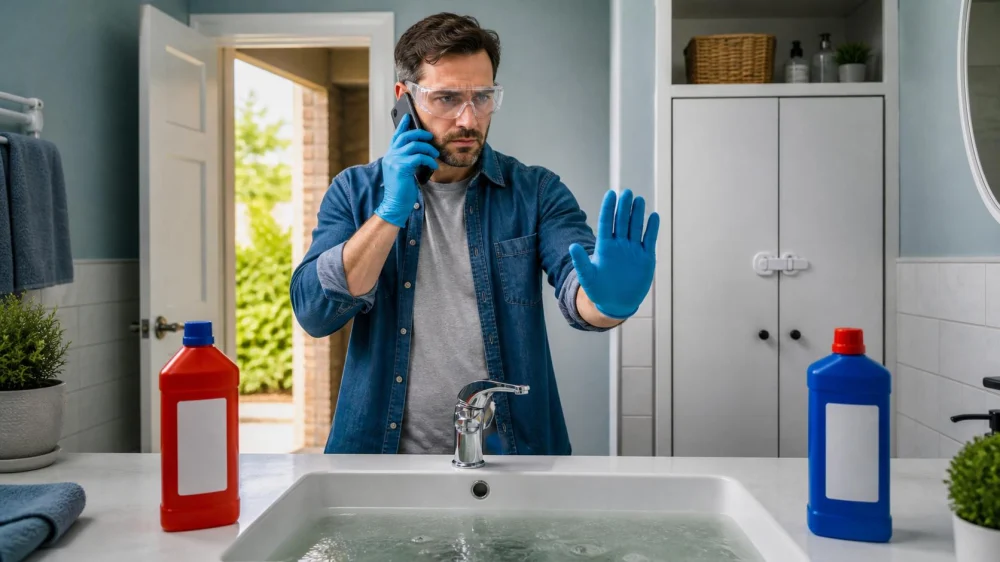
Never mix drain cleaner with bleach, ammonia, acids, disinfectants, another drain opener, or a homemade remedy. A blocked drain can trap corrosive liquid, create heat, release dangerous gas, and splash during plunging or disassembly. Stop using the fixture, ventilate only if you can do so without exposure, keep people and pets away, preserve the product container, and tell the plumber exactly what entered the drain. For exposure, call Poison Help at 1-800-222-1222; call 911 for breathing difficulty or severe symptoms.
Hardy Plumbing / hardy plumbing
Port ClintonSchuylkill CountyPennsylvania
149 Penn St, Port Clinton, PA 19549, USA
Why mixing is dangerous
Non-enzymatic drain cleaners may contain strong acids or alkalis such as sulfuric acid, hydrochloric acid, sodium hydroxide, or potassium hydroxide. These chemicals can burn skin, eyes, mouth, throat, lungs, and the digestive tract.
Adding another chemical does not simply make the first one stronger. It can cause an unpredictable reaction, release toxic or irritating gases, generate heat, boil or splatter liquid, and damage pipes or fixtures.
A drain that remains blocked keeps the chemical near the opening. A plunger, cable, trap removal, or compressed-air tool can then send contaminated liquid toward the user.
JetBlast Inc. Water Blasting Sewer & Drain Cleaning / jet blast drain cleaning
BaltimoreAnne Arundel CountyMaryland
6800 Fort Smallwood Rd, Baltimore, MD 21226, USA
Stop before adding anything
If any chemical product has already entered the drain:
- Do not add water unless the product label or Poison Control specifically directs it.
- Do not add another cleaner, bleach, vinegar, baking soda, ammonia, or disinfectant.
- Do not plunge, snake, vacuum, or dismantle the trap.
- Keep children, pets, and unprotected people away.
- Leave the area if fumes, burning eyes, coughing, or breathing symptoms occur.
- Save the original container and note the product, amount, and time used.
- Call Poison Control for exposure guidance and a plumber for safe removal of the blockage.
Do not lean over the drain to smell it. Odor is not a reliable measure of safety, and some exposures can reduce the ability to notice a chemical.
Use lower-risk mechanical steps
Before any chemical has been used, simple clogs may respond to a safer source-control approach. Stop water flow, remove visible hair or debris with a suitable tool, clean an accessible stopper, and use a plunger designed for the fixture if the plumbing condition permits.
Wear eye protection and gloves and keep the work area stable. Never reach into a garbage disposal; disconnect power and follow the appliance manual. Do not cable through unknown piping, shared drains, old corroded traps, or a line that may contain hazardous chemicals.
Call a licensed plumber for recurring clogs, multiple slow fixtures, sewage backup, gurgling with overflow risk, a suspected main-line blockage, inaccessible piping, or any drain that already contains a chemical.
Tell the plumber what is in the drain
When booking, state that a chemical drain product was used. Provide the exact name, active ingredients if visible, approximate amount, time, other products previously used, and whether anyone has symptoms.
Do not conceal the chemical because you are embarrassed. The technician needs that information to choose protective equipment, ventilation, tools, containment, and disposal methods.
Leave the product container available but closed and away from children. Do not transfer residue to an unlabelled bottle.
Respond to a chemical exposure
For U.S. poison exposure, contact Poison Help at 1-800-222-1222 or use webPOISONCONTROL for case-specific instructions. Call 911 for trouble breathing, collapse, seizure, severe chest symptoms, or another life-threatening condition.
Move away from fumes to fresh air if it is safe. For eye or skin contact, follow the product label and Poison Control directions; immediate water irrigation is commonly time-critical, but obtain specific guidance. Remove contaminated clothing carefully.
Do not induce vomiting after swallowing drain cleaner. Do not neutralize it with another chemical. Bring the container or product information to medical care without exposing others.
Store and dispose products safely
Keep cleaners in original labelled containers, tightly closed, upright, and locked away from children and pets. Separate incompatible chemicals according to their labels. Never reuse the container for food or drink.
Follow local household-hazardous-waste rules for unwanted product. Do not pour leftover chemicals together or put an unknown mixture into a drain, toilet, yard, or rubbish bin.
Limitations and important notes
This guide cannot identify an unknown chemical reaction or declare an area safe. Fire departments, hazardous-materials teams, poison specialists, public-health authorities, and plumbers may give different instructions based on the product and exposure.
People with asthma or lung disease may be especially sensitive to fumes. Do not re-enter an irritating area merely to open a window.
Sources and evidence notes
Poison Control explains that many drain cleaners are highly corrosive and can cause severe burns and splash-back. CDC warns never to mix household bleach or disinfectants with other cleaners because dangerous vapours can be released.
Frequently asked questions
Can I add vinegar after drain cleaner?
No. Do not add acids, alkalis, bleach, or any other cleaner to an unknown or existing drain chemical.
Can I plunge after using drain opener?
Do not. Plunging can splash corrosive liquid. Tell a plumber what was used.
Can I neutralize the cleaner?
Not yourself. Neutralization can generate heat or gas. Follow Poison Control and hazardous-material guidance.
What if no one has symptoms?
Keep the area restricted and call for safe plumbing advice. Lack of symptoms does not make the drain safe to dismantle.
Should I call Poison Control or a plumber?
Call Poison Control for a human exposure and a plumber for the blocked drain; call 911 for severe symptoms.
Next steps
If a chemical is in the drain now, add nothing, avoid mechanical work, isolate the area, save the container, and report the product to the plumber. For any exposure, contact Poison Help immediately and use 911 for severe symptoms.


 Pop Pop's Plumbing5.0 (210 reviews)
 3R Plumbing and Mechanical4.0 (346 reviews)
 Modern Plumbing & Heating Company4.0 (42 reviews)
 Outstanding Plumbing & Heating4.0 (42 reviews)
 AAA Plumbing, LLC3.0 (24 reviews)
 JSPlumbing&Piping5.0 (1 reviews)
 How to Prevent Hard Water Damage in Your Plumbing
 How to Fix and Unclog a Bathtub Drain – Complete Guide for Homeowners
 How to Maintain Your Home's Plumbing During the Summer
 How to Replace a Washing Machine Water Valve Step by Step Guide
 How Long Does It Take to Sump Pump Failure: Causes and Solutions
 How to Deal with Clogged Drains in Your Bathroom