
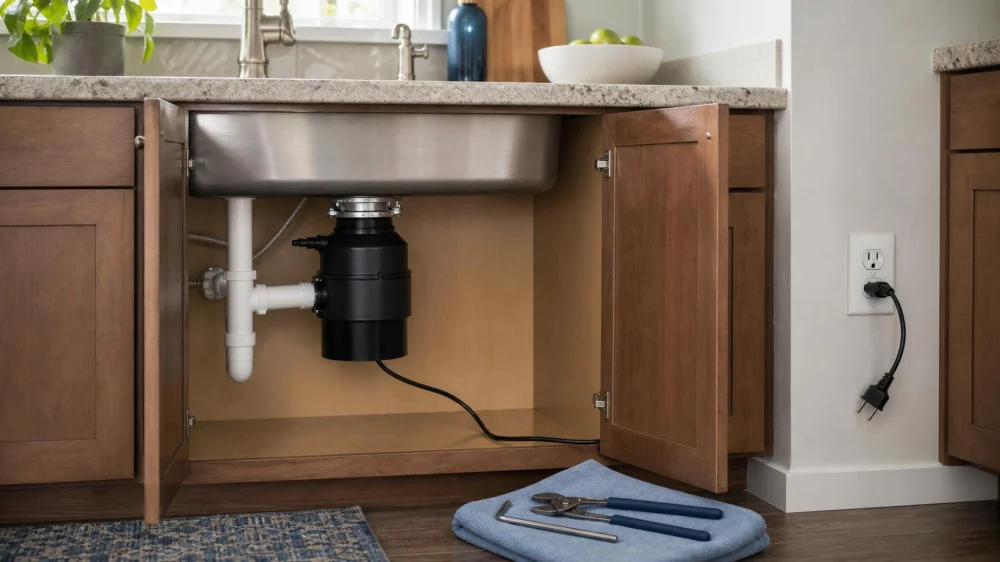
What to Do When a Garbage Disposal Hums but Won't Spin
On this page
- Quick answer
- What the humming sound usually means
- Make the disposal safe before checking it
- Step-by-step troubleshooting checklist
- What not to do
- When repair makes sense—and when replacement may be better
- When to call a plumber or electrician
- Important limitations and evidence notes
- Frequently asked questions
- Conclusion and next steps
Quick answer
A garbage disposal that hums but does not spin is often jammed or unable to start. Switch it off immediately, disconnect power at the plug or breaker, and never put a hand inside. Remove visible loose objects with tongs, use the manufacturer-approved unjamming method, restore power, then test briefly. Stop if it still hums, leaks, smells burned, trips the breaker, or will not turn freely.

Mike the Plumber / mike the plumber
1545 Ocean Ave A3, Bohemia, NY 11716, USA
What the humming sound usually means
The hum indicates that electrical power may be reaching the motor while the grinding mechanism is not rotating normally. A utensil fragment, hard food scrap, bone, fruit pit, or other object may be lodged between moving parts. The internal overload protector may also have tripped after the motor stalled.
Less commonly, the disposal may have a failed starting component, worn motor, damaged grinding assembly, loose electrical connection, or seized bearing. A sound alone cannot confirm which problem is present. Repeatedly energizing a stalled motor can overheat it, so turn the switch off as soon as you hear humming without normal movement.
This guidance is for homeowners and tenants dealing with a typical residential sink disposal. It is not ideal for commercial equipment, hardwired units with unclear circuits, flooded cabinets, or installations that already show electrical damage.

Sewer Xpress Corp / pipe xpress inc
Eastampton TownshipBurlington CountyNew Jersey
649 Powell Rd, Eastampton Township, NJ 08060, USA
Make the disposal safe before checking it
Treat the unit as capable of starting unexpectedly. A wall switch in the off position is not enough protection because it could be mislabeled, defective, or switched by someone else.
- Turn the disposal switch off and keep other people away from it.
- Unplug the disposal under the sink if its cord and receptacle are dry and safely accessible. If it is hardwired, switch off the correct circuit breaker.
- Verify that the disposal does not operate before bringing tools near the opening. If you cannot identify or disconnect the circuit, stop and call a qualified professional.
- Do not work in standing water or touch wet electrical components.
- Use a flashlight to look into the chamber, but never place fingers or a hand inside—even with power disconnected.
If the sink cabinet smells burned, contains melted insulation, makes crackling sounds, or has a hot receptacle, leave the circuit off and contact a licensed electrician. If water is actively leaking near wiring, avoid the wet area and seek urgent professional help.
Step-by-step troubleshooting checklist
- Stop the motor promptly. Move the wall switch to off as soon as the disposal hums without spinning. Do not keep flipping the switch to see whether it clears itself.
- Disconnect electrical power. Unplug the cord or turn off the confirmed breaker. If you rent, follow the property manager's maintenance process before disassembling anything.
- Check from above. Shine a light through the sink opening. Look for metal, glass, bone, a fruit pit, or another loose object. Do not reach into the chamber.
- Remove only clearly loose debris. Use long-handled tongs or pliers. Wear eye protection because fragments can be sharp. Do not pry on the grinding components or force an object that will not release.
- Use the approved turning point. Many disposals have a hex-shaped socket centered on the bottom. With power still disconnected, insert the correct manufacturer-specified wrench and work it gently back and forth. Other models require a different method, so check the unit's label and manual rather than improvising.
- Confirm free movement. The wrench should begin to move more easily after a simple jam clears. Stop if the shaft remains locked, the housing flexes, or excessive force would be required.
- Press the reset button once. After the unit has cooled and the jam is cleared, press the small overload-reset button on the bottom if the manual identifies one. Do not hold it in or repeatedly reset a unit that trips again.
- Restore power and test briefly. Remove every tool, run cold water, reconnect power, and pulse the switch for a second. A normal start should sound smooth. Switch it off immediately if it hums, grinds harshly, vibrates excessively, leaks, or smells hot.
- Check for leaks. With the unit off, inspect the sink flange, dishwasher connection, discharge pipe, and bottom housing. Water from the body or electrical area is a stop condition, not a reason to keep testing.
A brief successful test does not prove every fault is resolved. Run cold water and operate the disposal only as the manufacturer directs. If the jam returns, arrange an inspection rather than repeating the same reset cycle.
What not to do
- Do not put a hand into the disposal. Internal edges and loose fragments can injure you even when the motor is off.
- Do not use chemical drain cleaner. Caustic liquid can remain in the chamber, splash during service, damage some materials, and create a hazard for the next person who opens the plumbing.
- Do not strike the unit or force the turning tool. Excessive force can damage the shaft, mounts, sink seal, or plumbing connections.
- Do not run hot grease through it. Grease can cool and collect farther down the drain. Scrape fats and oils into an appropriate waste container instead.
- Do not assume every hum is a plumbing-only problem. Breaker trips, hot wiring, arcing, and damaged receptacles need electrical evaluation.
When repair makes sense—and when replacement may be better
Clearing one accessible obstruction may be reasonable when the unit is otherwise quiet, dry, securely mounted, and able to rotate freely after power is disconnected. A simple overload reset may also restore normal operation after a confirmed jam is removed and the motor cools.
Professional repair or replacement becomes more sensible when the motor remains seized, the same jam returns, the bottom housing leaks, the unit has severe corrosion, mounting parts are cracked, or the motor overheats quickly. Replacement may also be preferable when labor and unavailable parts make repair impractical. Do not choose by age alone; condition, repairability, electrical compatibility, sink mounting, local requirements, and total installed cost all matter.
Before buying a replacement, confirm the available cabinet space, existing mounting system, electrical connection, dishwasher drain connection, and any local permit or code requirements. A larger motor is not automatically the best choice for every household.
When to call a plumber or electrician
Call a plumber when an obstruction cannot be removed without disassembly, the disposal or drain connection leaks, the mounting assembly moves, the sink backs up, the shaft will not turn, or the unit repeatedly jams. For homeowners in Boone, North Carolina, a local plumbing professional can also check whether the problem extends into the trap or branch drain and explain repair-versus-replacement options for the installation.
Call a licensed electrician when the breaker trips repeatedly, a ground-fault device will not reset, wiring is loose or damaged, the receptacle is hot, lights flicker, or there is a burning smell or crackling sound. Some cases need both trades: a plumber for the wet-side installation and an electrician for the power connection.
Turn off the circuit and seek prompt help if water reaches electrical parts, smoke appears, or the cabinet becomes unusually hot. Do not keep testing while waiting for service.
Important limitations and evidence notes
These steps reflect common manufacturer safety guidance and standard residential troubleshooting practice: isolate power, avoid hand contact, remove only visible loose obstructions, use the model's approved turning method, and stop when electrical or mechanical damage is suspected. Disposal designs vary, so the label and manufacturer manual for the exact model take priority.
A homeowner check cannot measure motor windings, verify grounding, prove a circuit is de-energized, or assess hidden drain and wiring conditions. Electrical and plumbing rules vary across the United States and by local jurisdiction. When instructions conflict with the equipment manual, a lease, or local requirements, follow the applicable document and use a qualified professional.
Frequently asked questions
Why does my garbage disposal hum after I press reset?
The reset restores the overload protector; it does not remove a physical jam or repair a failed motor. Switch the unit off, disconnect power, and check whether the grinding assembly can be freed using the model's approved method. If it remains locked or hums again, stop testing.
Can I use a broom handle to turn the disposal?
Some informal advice suggests levering the grinding plate from above, but this can damage parts or slip. Use the manufacturer-specified tool and access point. If the manual does not describe a safe unjamming method, call a professional.
Should I pour baking soda and vinegar into a humming disposal?
No household mixture can free a seized motor or safely remove a hard object. It may foam or reduce some odor, but it does not diagnose the mechanical problem. Disconnect power and address the obstruction or equipment fault first.
What if the disposal is silent instead of humming?
A silent unit may have no power, a tripped overload, a failed switch, a ground-fault interruption, disconnected wiring, or a motor fault. Confirm the switch is off before checking the plug or reset. Leave breaker, receptacle, and wiring diagnosis to a qualified person if the cause is not obvious.
Can I keep using the sink while the disposal is broken?
A small amount of water may pass through some disabled units, but use can worsen a clog or leak. Do not use the sink if water backs up, the disposal body leaks, electrical parts could get wet, or a service professional has advised isolation. Avoid sending food scraps through the drain.
Conclusion and next steps
When a disposal hums without spinning, switch it off, disconnect power, inspect without using your hands, and try only the model-approved unjamming and reset steps. A freely moving, dry unit may return to service after one brief test. Persistent humming, heat, leakage, breaker trips, or a locked shaft means it is time to stop and arrange professional diagnosis.
 DAQ,S PLUMBING LLC5.0 (125 reviews)
 Eugene W. Hankee & Son Plumbing-Heating4.0 (12 reviews)
 Hub Plumbing & Heating4.0 (51 reviews)
 TNT Plumbing & Drain Service, LLC4.0 (92 reviews)
 Di Gravio Plumbing and Heating4.0 (72 reviews)
 Shannon's Plumbing3.0 (10 reviews)
 How to Prevent Mold Growth in Your Plumbing System
 What Causes Hot Water to Smell Bad? Understanding the Real Reasons Behind It
 When Should You Call a Plumber for a Broken Water Heater
 When Should You Call a Plumber for Unclogging a Bathtub Drain
 How to Unclog a Drain Using a Plunger
 Expert Advice on Finding a Reliable Plumber