
Low Flow at One Faucet? Check the Aerator First
On this page
Quick answer
If only one faucet has weak flow on both hot and cold, its aerator may be clogged with mineral scale or debris. Close the drain, remove the aerator using the correct method, photograph the part order, rinse and brush the screens, then reinstall without overtightening. Stop if the faucet is damaged, a hidden fitting moves or flow remains weak without the aerator.
This guide is for common household sink faucets with a removable outlet aerator. Pull-down kitchen sprays, touchless faucets, laminar outlets, hidden-cache aerators and specialty fixtures may need a key or manufacturer-specific service. Follow the faucet manual when available.
JetBlast Inc. Water Blasting Sewer & Drain Cleaning / jet blast drain cleaning
BaltimoreAnne Arundel CountyMaryland
6800 Fort Smallwood Rd, Baltimore, MD 21226, USA
Confirm the problem is limited to one faucet
Low flow describes a small volume of water leaving the outlet. Low pressure describes the force available in the supply system. They can feel similar at a faucet, but a clogged outlet restricts flow locally without proving that the home's water pressure is low.
Before taking anything apart, compare:
- The hot side and cold side at the affected faucet.
- Another faucet in the same bathroom or kitchen.
- A fixture on the same floor and one elsewhere in the home.
- Flow with no other water-using appliance running.
- Whether the change was sudden, gradual or started after plumbing work.
If both hot and cold are weak at one faucet while other fixtures are normal, the aerator or faucet outlet is a sensible first check. If only hot or only cold is weak, the cause may be a supply valve, connector, cartridge, debris in one inlet or a water-heater-related issue.
If several fixtures changed together, do not focus on one aerator. Check for a partly closed main valve, pressure regulator issue, utility work, leak, frozen pipe or another system problem. Water spraying, a spinning meter with fixtures off, damp building material or a sudden major pressure change needs prompt investigation.

coastal & son, llc / aj appliance toms river nj
Toms RiverOcean CountyNew Jersey
1106 Verdant Rd, Toms River, NJ 08753, USA
What a faucet aerator does
A faucet aerator is the small assembly at the end of a spout that shapes the stream and commonly mixes air with water. It can contain a housing, gasket, screens, flow-control insert and stream straightener. The parts vary by model.
Small openings can collect:
- Mineral scale from water.
- Sand or sediment after utility or well work.
- Fragments from deteriorating washers or plumbing material.
- Debris released after a shutoff valve or pipe was serviced.
Visible white or greenish crust around the outlet suggests scale, but internal debris may not be visible until the insert is removed. A distorted, sideways or split stream can also point to a dirty or misassembled aerator.
Some modern faucets use a recessed aerator that sits inside the spout. It may require a plastic cache key supplied with the fixture. Pliers can damage the insert or finish, so identify the design before applying force.
Remove and inspect it carefully
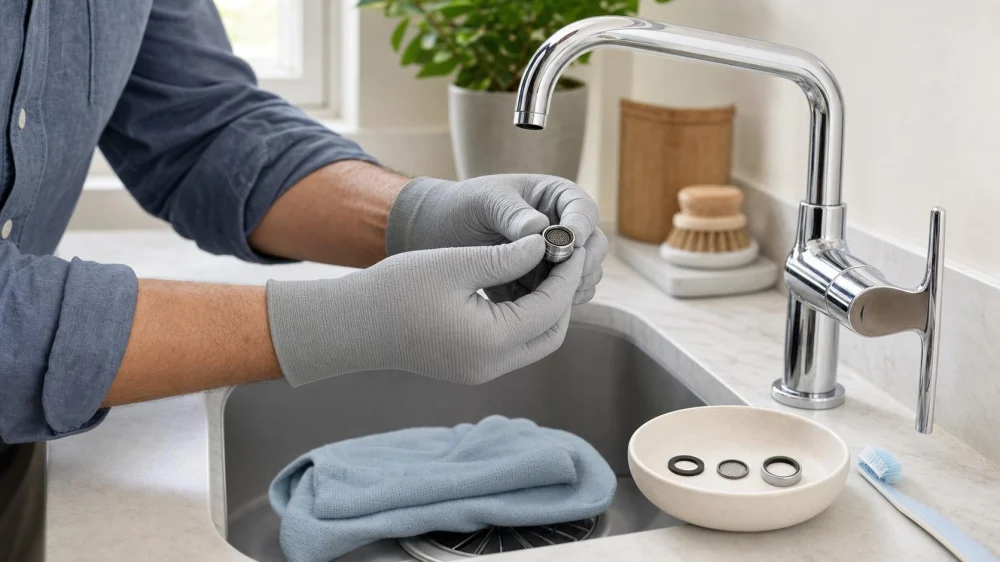
Gather a towel, bowl, old toothbrush or soft nylon brush, the correct aerator key when required, and nonslip gloves. Avoid metal picks that can puncture screens.
- Turn off the faucet. You normally do not need to close the under-sink valves for an outlet aerator, but verify the handle is fully off.
- Close or cover the drain. Small inserts and gaskets can disappear into the trap.
- Protect the finish. Try hand removal first. For an external housing, wrap it with a cloth or rubber strap. Use a suitable wrench only when the manufacturer permits it.
- Turn in the correct direction. Viewed from the outlet end, a standard threaded aerator usually loosens counter-clockwise, but orientation and design can be confusing. Stop if it tightens or the spout moves.
- Catch the parts. Lower the assembly into the bowl rather than pulling it apart over the sink.
- Photograph the stack. Record the order and direction of each gasket, screen and insert before separation.
- Inspect threads and seals. Look for cracks, flattened gaskets, crossed threads, torn screens and heavy corrosion.
If the aerator will not move with moderate correct effort, pause. Forcing it can twist a thin spout, break an internal connection or scratch a finish. A plumber or faucet manufacturer can identify a hidden tool or replacement.
Clean and reinstall the aerator
Rinse loose debris from each part in a bowl so you can see what came out. Brush screens gently from both sides. Do not enlarge holes with a needle or drill; changing the insert can create spray, noise and unnecessary water use.
For mineral scale, soak only compatible removable parts in the descaling method recommended by the faucet manufacturer. Mild white vinegar is commonly used for some metal and plastic aerators, but acids can damage certain finishes, rubber, stone surfaces and specialty coatings. Keep the faucet finish dry and follow time and material limits.
Rinse every part thoroughly. Reassemble in the photographed order, with the gasket seated flat. Start the housing by hand to avoid cross-threading. Tighten until snug and sealed, not as hard as possible.
Open the faucet slowly and inspect the stream and housing. If water leaks around the aerator, turn it off, remove the assembly and check the gasket position and threads. Do not solve a leak by continuing to tighten a damaged or misassembled part.
If the flow returns to normal, let both hot and cold run briefly according to local water conditions and fixture instructions, then clean the sink. Record repeated debris because it may point to a supply-side source.
What to check when flow stays low
With the aerator removed, direct the spout into the sink and open the faucet briefly at a controlled rate. Stay ready to close it because the unaerated stream can splash. If flow is strong without the aerator, replace a damaged or permanently restricted aerator with the exact compatible type and flow specification.
If flow is still weak without the aerator, stop focusing on the outlet. Possible causes include:
- A partially closed or failed under-sink stop valve.
- A kinked, crushed or internally degraded flexible connector.
- Debris in the faucet cartridge or inlet screen.
- A failing pull-down spray head or diverter.
- A touchless-faucet solenoid or power issue.
- Pipe scale, freezing, leakage or another supply restriction.
Look without moving pipes or valves: are both stop valves fully open, are supply lines kinked, is there moisture, corrosion or cabinet swelling, and did the problem begin after a repair? Do not turn a corroded valve that appears likely to leak unless you can isolate water and handle the result.
When only one temperature is affected, swap testing can be more complex and may expose you to hot water or create a leak. A plumber can measure flow, isolate the faucet, inspect the cartridge and verify supply conditions without guessing.
Important limits and plumber triggers
Call a qualified plumber serving Boone when the aerator is seized, the spout turns while loosening, an under-sink valve leaks, a connector bulges or corrodes, flow remains low without the aerator, debris returns quickly, or multiple fixtures are affected.
Also seek help for discoloured water that does not clear as directed by the water provider, suspected contamination, a sudden unexplained pressure loss, frozen plumbing, hidden moisture or a faucet connected to an unfamiliar filtration or treatment system.
When requesting service, describe whether hot, cold or both are weak; which other fixtures are normal; when the change began; whether recent plumbing or utility work occurred; and what debris appeared. This helps a Boone-area plumber bring the right diagnostic tools and parts.
Frequently asked questions
Can I clean an aerator without removing it?
Surface cleaning may improve visible scale, but it will not reliably clear internal screens. A bag of descaler tied around the spout can damage finishes or leak onto stone. Use the manufacturer-approved method.
Do I need to shut off water under the sink?
Usually not for a removable outlet aerator because the faucet handle controls flow. Close the faucet fully and cover the drain. If you will service the cartridge or supply, isolation is required.
Why is the stream worse after reassembly?
A screen may be reversed, the gasket may be displaced, debris may remain, or the insert may be damaged. Compare the parts with your photo or the manufacturer's diagram and do not force mismatched pieces.
Can I leave the aerator off?
The faucet may operate, but the stream can splash and use more water, and the outlet loses its intended flow control. Install the correct compatible replacement.
How often should I clean a faucet aerator?
There is no universal interval. Inspect it when the stream distorts or flow falls. Water hardness, pipe work, sediment and fixture design affect how quickly debris accumulates.
Sources and evidence notes
This article reflects common faucet and aerator construction and conservative household-plumbing practice. Thread direction, materials, flow-control parts and cleaning compatibility vary by manufacturer. The faucet manual and local water provider's current guidance take priority.
Conclusion and next steps
When one faucet has low flow on both hot and cold, confirm other fixtures are normal and inspect the aerator before assuming a whole-home pressure problem. Remove it carefully, preserve the part order, clean with a compatible method and reinstall by hand. If flow stays weak with the aerator removed or plumbing moves, leaks or corrodes, stop and contact a qualified plumber serving Boone.

 My Dear Watson Plumbing, Heating & Cooling4.0 (27 reviews)
 J.G.Henry Plumbing and Heating Services and Remodeling3.0 (5 reviews)
 Jay's Plumbing Service LLC3.0 (3 reviews)
 Deluca Plumbing & Heating4.0 (5 reviews)
 Mazzacone Plumbing & Heating4.0 (36 reviews)
 Bellio Plumbing & Heating4.0 (96 reviews)
 How Often Should You Replace Old Pipes?
 Why Is My Clogged Drain Happening? Common Causes & Solutions
 How to Identify and Fix Leaks in Your Plumbing System
 Why Is My Garbage Disposal Humming But Not Working? Common Causes and Solutions
 Expert Advice on Fixing a Garbage Disposal
 What Is the Average Cost to Install Tankless Water Heater?